Into the Bunker
Attempts
Around 1970, a nearly two-decade-long phase began in which Volkskundemuseum Wien tried to gain access to the air-raid shelter despite resistance and inaction on the part of the city and federal administrations. This intense and eventful phase started at the end of 1969, when the then Director, Leopold Schmidt (1912–1981), tentatively approached the (supposedly) responsible city administration department to advance the pressing concerns of the museum. In a letter to Vice Mayor Gertrud (Fröhlich-)Sandner (1926–2008), he “once again” reminded her that the Schönborn Garden Palace (Laudongasse 15–19, 8th district), where the museum had been located since 1917, had “long since become too small” and was bursting at the seams with its ever-growing collections (Ill. 1). Schmidt pointed out that there would be a “relatively easy” solution to the lack of space, referring to the “’bunker’ that adorned Schönborn-Park, adjacent to the museum building, during the last war”1. In addition to the size of the structure, he went on to list additional benefits that would help solve other pressing issues: an extension on top could create an exhibition hall where the collection objects could finally be displayed to the public. They had previously been housed in Schönborn Garden Palace, simultaneously used for both exhibition and storage purposes. An additional effect, according to Schmidt, would be the “utilization of the now completely unnecessary bunker”. Schmidt considered this option to be a cost-effective way for potential funding parties to create a new museum, which would also promote cultural life in the 8th district. Furthermore, he saw an aesthetic advantage: the new hall would “conceal the unsightly rear façades of the tenement houses, which unpleasantly protrude into Schönbornpark”2.


Setbacks
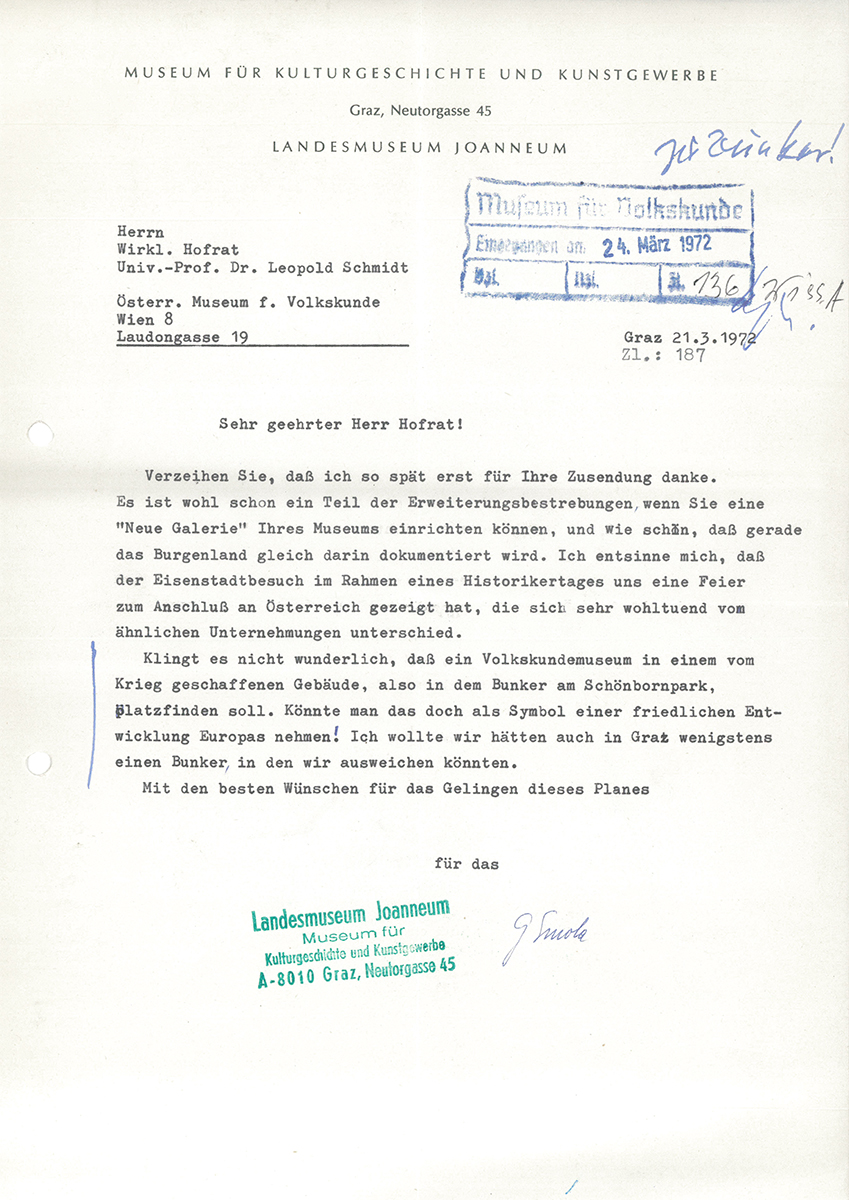
The city administration’s response3 to the letter, addressed to “österreichische Museum für Völkerkunde“ [sic], showed little interest, stating that “Federal Administration is the owner of the Schönborn-Park bunker” and the Federal Ministry of Education was responsible for scientific museums. This initiated the so-called ‘bunker resolution’: the museum and the Verein für Volkskunde (Ethnographic Society) turned to a new, hopefully more constructive counterpart, the ministry and federal administration. For broader awareness, the Resolution on Museum Expansion was printed in the Journal Österreichische Zeitschrift für Volkskunde in 1971, published by the Verein für Volkskunde, and sent to 300 “esteemed friends of Austrian ethnography”, including an accompanying letter (Ill. 2), for information and support. The letter stated that, after the clarification of who was responsible for the issue, museum management immediately approached the Ministry of Science and Research with a new request to consider “an expansion of the museum through the development and adaptation of the bunker”. The Favoriten Volkshochschule adult education centre at Arthaberplatz was mentioned as an example of a successful shelter conversion project (see chapter 2: Becoming INvisible). The underground rooms of the Schönbornpark shelter were intended to be used as a museum depot and for a study collection. The resolution again used the low costs as an argument, stating that reusing such a shelter and adding an extension “would save a lot of construction costs”. The museum’s management was particularly convinced that “this expansion and modernisation of the museum would be an additional asset to the 8th district of Vienna, which in recent years has become more deeply integrated into the inner circle of Vienna’s cultural life through the relocation of university institutes and the construction of the House of Books”4. The ministry remained cautious and did not want to commit to an extension, as Vienna City Administration opposed these plans on the grounds that “this would lead to further destruction of the recreational area and environmental conditions (sunlight, shade, etc.)”5. For the same reason, it was stated, a decision had been made years earlier against a similar on-top extension for the House of Books municipal project. However, it could be possible to convert the interior of the shelter into exhibition spaces and connect it to the museum through a passage. It is worth noting that, following the ‘bunker resolution’, the Joanneum Museum of Graz wrote a letter to Volkskundemuseum that offered a unique interpretation of the plans for the building. The colleague from Graz wrote that it sounded “curious”6 that “an ethnographic museum should find a place in a building created by war, i.e., in the bunker at Schönbornpark”. She wanted to take this as a “symbol of peaceful development in Europe!”, whishing that “we in Graz, too, had at least one bunker that we could use” (Ill. 3).
Everything changed again the year after: the ministry informed the Verein für Volkskunde that the shelter was indeed owned by Vienna City Administration, with city administration department 42 (MA 42, Vienna City Gardens) being the competent authority for the matter. Furthermore, it found that “the interior of the bunker serves various municipal departments as storage and depot (e.g., also as a book storage for the Central Library)”7 and would continue to be needed for this purpose. “It is therefore unlikely that in the foreseeable future it will be possible to make space for the purposes of the Österreichisches Museum für Volkskunde.”

Ideas
Although not much can be found in the museum archives about later developments, a change seems to have taken place from the mid-1970s. An article published in the district newspaper Westend entitled “Concrete Bunker for Museum”8 mentioned the poor condition of the war and civil defence structure and elaborated on the interest of the “Socialist Party” in supporting the museum to make “one of the ugliest points in the district” disappear (Ill. 4). In 1978, Klaus Beitl (1929–2026) became the new Director of Volkskundemuseum and resumed correspondence and initiatives relating to the air-raid shelter. In a letter to various (potentially) responsible individuals, he outlined the general situation of the museum regarding building restoration and space requirements. Again, Beitl demanded that the ownership rights of the shelter be established and the museum be allowed to use it for its own purposes.9 In a letter to the competent city councillor responsible for the matter, Peter Schieder (1941–2013), Beitl referred to changed circumstances and the building’s poor condition, which would now also affect the museum building: “This structure from the last war has not been regularly used since the City Library moved into its new building on Laudongasse.” The condition of the structure offered “by no means a pleasant sight”, and the lack of supervision had even led to “damage to the side of the museum building facing the garden”. However, Vienna City Administration communicated its own plans for the shelter in 1978. A district brochure mentioned that plans had been made for a “cultural and leisure centre with a swimming pool”10 to be built in Schönbornpark. The People’s Party (ÖVP) presented concrete plans in June 1978 that included an indoor pool built on top of the air-raid shelter. In an undated file note, museum employee and later Museum Director Franz Grieshofer (*1940) recorded that he had attended the presentation of the “ÖVP model for a recreational and swimming centre in Schönbornpark” (Ill. 5). He also expressed the museum’s concerns that these plans could conflict with the museum’s depot plans.11 The ÖVP district executive stated that the museum would play an important role in the project, as it should be “integrated into the indoor pool construction and offer cultural activities for the recreational zone”. Although Grieshofer could, in principle, envision cultural participation on part of the museum, he nevertheless noted that the museum had other plans.


Moving in
(Ill. 6) Beitl’s efforts and extensive correspondence ultimately collided with a change in strategy on the part of the city administration and the relevant municipal departments (MA 42, MA 7 (Culture), MA 52 (between 1920 and 1996 Residential Building Administration)). In July 1978, Volkskundemuseum reached an agreement with Vienna City Administration. In August, MA 7 cleared out the rooms they had previously used as book storage. An official request for the space followed. In October, the keys to parts of the air-raid shelter were handed over and the museum obtained initial quotes for electrical and carpentry work and, particularly urgent, air dehumidification systems. In a letter sent to the Federal Ministry in November 1979, Klaus Beitl reported that the now used rooms in the shelter had made it possible to transform the “depot stocks, previously stored in cramped rooms in boxes, chests and cabinets in a completely inadequate and ultimately irresponsible manner from a conservational and scientific point of view, into an exemplary and systematic study collection”12. The museum, he stated, could finally meet the current standards and, by solving the immediate space problem, had also started working on the “preparatory-conservational treatment” of the objects and the “systematic photographic, inventory- and catalogue-based re-recording”13. To continue all these projects, Beitl advocated that the remaining rooms in the shelter be fully vacated and handed over to the museum. In mid-1980, an agreement was reached to transfer the entire air-raid shelter to Volkskundemuseum. In October 1980, the ministry granted a special allocation of 270,000 schillings for the “adaptation of the former air-raid bunker Schönbornpark as a study collection”14. On 1 January 1981, the usage agreement for the shelter, concluded between MA 42 and Volkskundemuseum, came into effect – the museum could now adapt and use all of the inside of the Schönbornpark air-raid shelter.


- (Translation); original quotes: “wieder”; “längst zu klein geworden”; “verhältnismäßig leicht”; “‚Bunker‘, mit dem der an das Museumsgebäude angrenzende Schönborn-Park im letzten Krieg verziert wurde”; cf. letter from Leopold Schmidt to the City of Vienna Council Sandner, Geschäftsgruppe III, Kultur und Volksbildung: “Betr. Wiener Stadtforschung – Wiener Großstadtvolkskunde”, 4 pages; air-raid shelter archive folder 1969, Volkskundemuseum Wien archive.
- (Translation); original quotes: “Nutzbarmachung des heute völlig unnötigen Bunkers”; “die unansehnlichen Rückfronten der Zinshäuser etwas verdecken, die unschön in den Schönbornpark hineinschauen”; ibid.
- (Translation); original quote: “der Bund Eigentümer des Bunkers im Schönborn-Park”; letter from Head of Department Foltinek (MA 7) to Leopold Schmidt, 2 June 1970, 1 page; air-raid shelter archive folder 1969, Volkskundemuseum Wien archive.
- (Translation); original quotes: “eine Museumserweiterung durch Ausbau und Adaptierung des Bunkers”; “doch viel Baukosten sparen”; “daß durch diese Erweiterung und Modernisierung des Museums der 8. Wiener Gemeindebezirk, der in den letzten Jahren durch die Verlegung von Universitätsinstituten und durch die Errichtung des Hauses des Buches stärker in den inneren Kreis des Wiener Kulturlebens gerückt worden [ist], einen weiteren bedeutenden Akzent erhalten würde”; letter from the museum to the Federal Minister for Science and Research: “Resolution über Erweiterung“, 26 March 1971, 3 pages; air-raid shelter archive folder 1969, Volkskundemuseum Wien archive.
- (Translation); original quote: “daß damit eine weitere Zerstörung des Erholungsraumes und der Umweltsbedingungen [sic]) (Besonnung, Beschattung etc.) verbunden wäre“; letter from the Federal Minister for Science and Research to the museum, 2 February 1971, 1 page; air-raid shelter archive folder 1969, Volkskundemuseum Wien archive.
- Translation); original quotes: “wunderlich“; “Symbol einer friedlichen Entwicklung Europas nehmen!“; “wir auch in Graz wenigstens einen Bunker (hätten), in den wir ausweichen könnten“; letter from G. Smola of Landesmuseum Joanneum to Leopold Schmidt, 24 March 1972, 1 page; air-raid shelter archive folder 1969, Volkskundemuseum Wien archive.
- (Translation); original quotes: “der Innenraum des Bunkers verschiedenen magistratischen Dienststellen als Lager und Depot (z.B. auch als Bücherspeicher für die städtische Zentralbibliothek)“; “Eine Freimachung für Zwecke des Österreichischen Museums für Volkskunde dürfte daher in absehbarer Zeit wahrscheinlich nicht möglich sein.“; letter from Minister Firnberg to Verein für Volkskunde, 8 February 1972, 2 pages; air-raid shelter archive folder 1969, Volkskundemuseum Wien archive.
- (Translation); original quotes: “Betonbunker für Museum“; “einen der häßlichsten Punkte des Bezirkes“; n. n.: Betonbunker für Museum. In: westend. Bezirkszeitung für Neubau, Josefstadt und Rudolfsheim-Fünfhaus. 2/76, p. 12; air-raid shelter press museum archive folder, Volkskundemuseum Wien archive.
- See, for example, letter from Klaus Beitl to the Culture Department of Vienna City Administration, 12 January 1978, 2 pages; air-raid shelter archive folder 1969, Volkskundemuseum Wien archive.
- (Translation); original quote: “Kultur- und Freizeitzentrum mit Schwimmbad errichtet werden”; brochure “wien. 8. Bezirk Josefstadt”, published by the Press and Information Service of the City of Vienna, April 1978; air-raid shelter press museum archive folder, Volkskundemuseum Wien archive.
- (Translation); original quote: “in den Hallenbadbau integriert werden und für die Freizeitzone kulturelle Aktivitäten anbieten“; file note by Franz Grieshofer, undated (1978), 1 page; air-raid shelter archive folder 1969, Volkskundemuseum Wien archive.
- (Translation); original quote: “in den beengten Räumen in Kisten, Truhen und Schränken vom konservatorischen und wissenschaftlichen Standpunkt her gesehen gänzlich unzulänglich und letzten Endes unverantwortlich gelagerten Depotbestände in eine […] mustergültige und systematische Studiensammlung“; letter to Minister Firnberg, Federal Ministry of Education and Research: “Erweiterung der Studiensammlung im Bunker Schönbornpark“, 2 November 1979, 2 pages; air-raid shelter archive folder 1969, Volkskundemuseum Wien archive.
- (Translation); original quote: “präparatorisch-konservatorische Behandlung“; “systematisch-photographische und inventar- sowie karteimäßige Neuerfassung“; ibid.
- (Translation); original quote: “präparatorisch-konservatorische Behandlung“; “systematisch-photographische und inventar- sowie karteimäßige Neuerfassung“; ibid(Translation); original quote: “Adaptierung des ehemaligen Luftschutzbunkers Schönbornpark als Studiensammlung“; letter from the Federal Ministry of Education and Research to the management of the museum: “Gewährung der Sonderdotation“, 13 October 1980; air-raid shelter archive folder 1969, Volkskundemuseum Wien archive.