
War and Air-Raid Protection in Vienna
A new form of war
Already during World War One, the deployment of aircrafts had brought new dimensions of warfare. Rapid technological developments meant that warfare increasingly took place in the hinterland and on the ‘home front’. German air raids on London in 1915/16, carried out using airships and large aircrafts, were an example of this early strategic air warfare. In the Austrian context, the 1918 flight of the Italian pilot Gabriele D’Annunzio to Vienna – more a propaganda spectacle than a military strike – marked a turning point. It highlighted not only the military but also the symbolic and psychological potential of aerial warfare. At this point, if not before, the previously constructed line dividing the male ‘front’ and the female ‘home’ increasingly began to blur. The war now affected the entirety of society on a previously unknown scale. Even though aerial warfare, and bomb attacks in particular, had not yet fully develoved by the end of World War One, there was a clear foreshadowing of future forms of armed conflict. Not least because of this, military decision-makers and strategists in the interwar period increasingly concerned themselves with aerial warfare. This gave rise to the idea that future wars would be waged exclusively from the air, with the aim of destroying or at least severely damaging opponents’ societies. These plans and horror scenarios led to an international arms race and the development of large bomber fleets. Austria did not participate in this due to the provisions of the 1919 Treaty of Saint-Germain. Instead, the discussion in Austria shifted to protecting its population from potential air raids. The goal was to make the population more resilient to the physical, and above all psychological, consequences of a bombing campaign. This led to the development and (gradual) institutionalisation of comprehensive civilian air-raid protection measures. Newly founded organisations such as the Austrian Air Protection League (Österreichischer Luftschutzbund) soon reached large segments of the population. Particularly in urban areas, intensive air-raid drills, such as large-scale blackout exercises, were conducted to teach appropriate self-protection (e.g., what to do in the event of an air raid; Ill. 1 and 2) to the population, with the aim of raising awareness of the danger coming from above.
Lectures and training sessions were organised to convey knowledge and promote social cohesion.

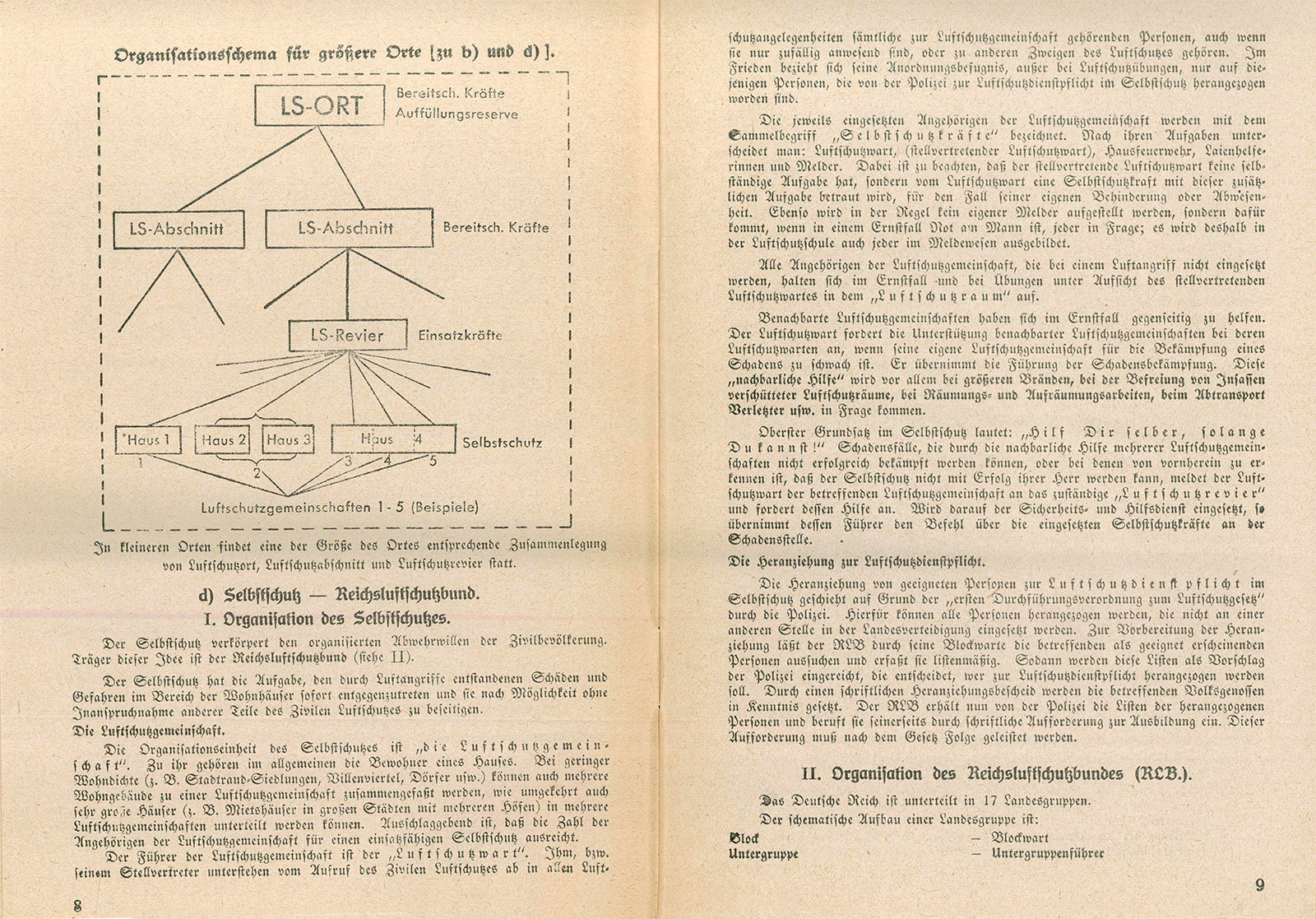
“If as much as a single enemy aircraft flies over German soil, my name is Meier!”
The outbreak of World War Two led to an almost immediate onset of bombing campaigns against cities and civilian populations. Initial German air raids against major cities such as Warsaw in 1939 or Rotterdam in 1940 quickly escalated into a full-scale aerial war, which reached its first peak that same year during the Battle of Britain. With France’s surrender to Nazi Germany in the summer of 1940, the only option left for Great Britain – and, starting in 1941, for the United States – was to launch a strategic bombing campaign in order to have a military impact on continental Europe now occupied by the Nazis. Aerial warfare quickly spread. In 1942, the first thousand-bomber raid was carried out in Cologne; in 1943, Hamburg was almost completely destroyed in a firestorm unleashed by bomb attacks.1 Hermann Göring, Reich Minister of Aviation and Commander-in-Chief of the Luftwaffe, is said to have boastfully promised before the outbreak of the bombing campaign that no Allied aircraft would reach Berlin, or else his name was “Meier”. By 1943, this promise sounded like mockery.
Bomb attacks remained confined to one region for a long time. British and U.S. bomber formations took off almost exclusively from bases on the British Isles until 1943, striking primarily western and northern Germany. Because of the great distance and the natural barrier of the Alps, the Alpine region, including the territory of present-day Austria, remained largely spared from air raids until August 1943.
However, with the stationing of Allied bombers in North Africa and Malta – and, from late 1943, near Foggia, Italy – the southeastern Reichsgaue (Reich Districts) of the Nazi German Reich, particularly the Alpine and Danube districts, increasingly came within the Allies’ operational radius. From 1943 onward, attacks carried out by the newly formed 15th US Army Air Force and the No. 205 Group of the Royal Air Force (RAF) primarily focused on industrial plants critical to war efforts, on military facilities, oil-producing regions, as well as central transportation and supply hubs in the Alpine region and southeastern Europe. As one of the first cities in ‘Austria’, Wiener Neustadt, with its arms factories, became a target for Allied bombers squadrons.2
Air defence and flak towers
The German Reich rapidly established extensive defensive measures based on a layered system. Allied bomber squadrons entering the airspace of the German Reich were detected early by German air traffic control stations. Anti-aircraft positions were put on alert, and fighter planes were prepared to intercept the target. The fighter planes’ task was to attack enemy bombers before they reached their target area, to destroy them, if possible, or to force them to turn back before bombs were dropped. Anti-aircraft guns – known as Flugabwehrkanonen (Flak) – were deployed along flight paths and near or within cities. In cities such as Vienna, distinctive flak bunkers (also known as flak towers; see Chapter 2: Becoming INvisible) – still visible today – were built. By 1944, the German Luftwaffe was barely able to effectively counter the Allied bomber squadrons, leaving cities like Vienna increasingly unprotected. The air-raid siren became a constant companion to life in the major cities of the German Reich. All that citizens could do was rushing to the air-raid bunkers and cellars every day.
Air-raid protection
At the start of the war in 1939, people generally believed in the superiority of the Luftwaffe, which gave a false sense of security to large segments of the population. This belief initially resulted in hesitation towards implementing comprehensive air-raid protection measures. It was only as the threat intensified that civilian air-raid protection was carried out systematically: cellars and basements were converted into air-raid shelters (see Chapter 1: Air-Raid Protection at Volkskundemuseum Wien), anti-shrapnel trenches were built, public air-raid shelters and bunkers were erected, and fire ponds created. In addition to that, basement walls were demolished to connect underground structures and emergency exits were created in streets. Attics were cleared of clutter and treated with fire-retardants. A multi-tiered warning system helped the population to assess the danger at hand. The ‘cuckoo’ on the radio signalled that bomber formations were approaching and was intended to alert the population to the impending danger even before the sirens sounded. This was followed by a public air-raid warning, then by an air-raid alarm in the affected area. Only the ‘all-clear’ siren signalled the end of the danger.
“Air-raid protection is self-protection”3 – “Tell everyone”4
A multitude of regulations and provisions governed civil air-raid protection in all its aspects. A central measure was the complete blackout of all light sources from before nightfall until daybreak. Compliance with blackout regulations was strictly enforced by the police and the Reichsluftschutzbund (Reich Air-Raid Protection League). Violations were punished with severe penalties. To aid navigation in the dark, sidewalks in urban areas were marked with white paint. Additionally, arrows and signs painted on buildings and along streets in self-luminous phosphorescent paint made it easier to locate air-raid shelters.


Georg Hoffmann, Director of the Museum of Military History (Heeresgeschichtliches Museum, HGM) in Vienna and Aerial Warfare Historian
The air-raid shelter: a place of protection – a place of control
To protect the civilian population from the growing threat of air raids, the systematic construction of air-raid shelters began in major cities such as Vienna as part of the Führer-Sofortprogramm (Führer Emergency Programme). Between December 1940 and September 1941, the Vienna City Planning Office constructed several of these facilities, particularly in parks, as they were often the only available open spaces within the densely built urban area.

Nicole-Melanie Goll, Historian

Nicole-Melanie Goll, Historian
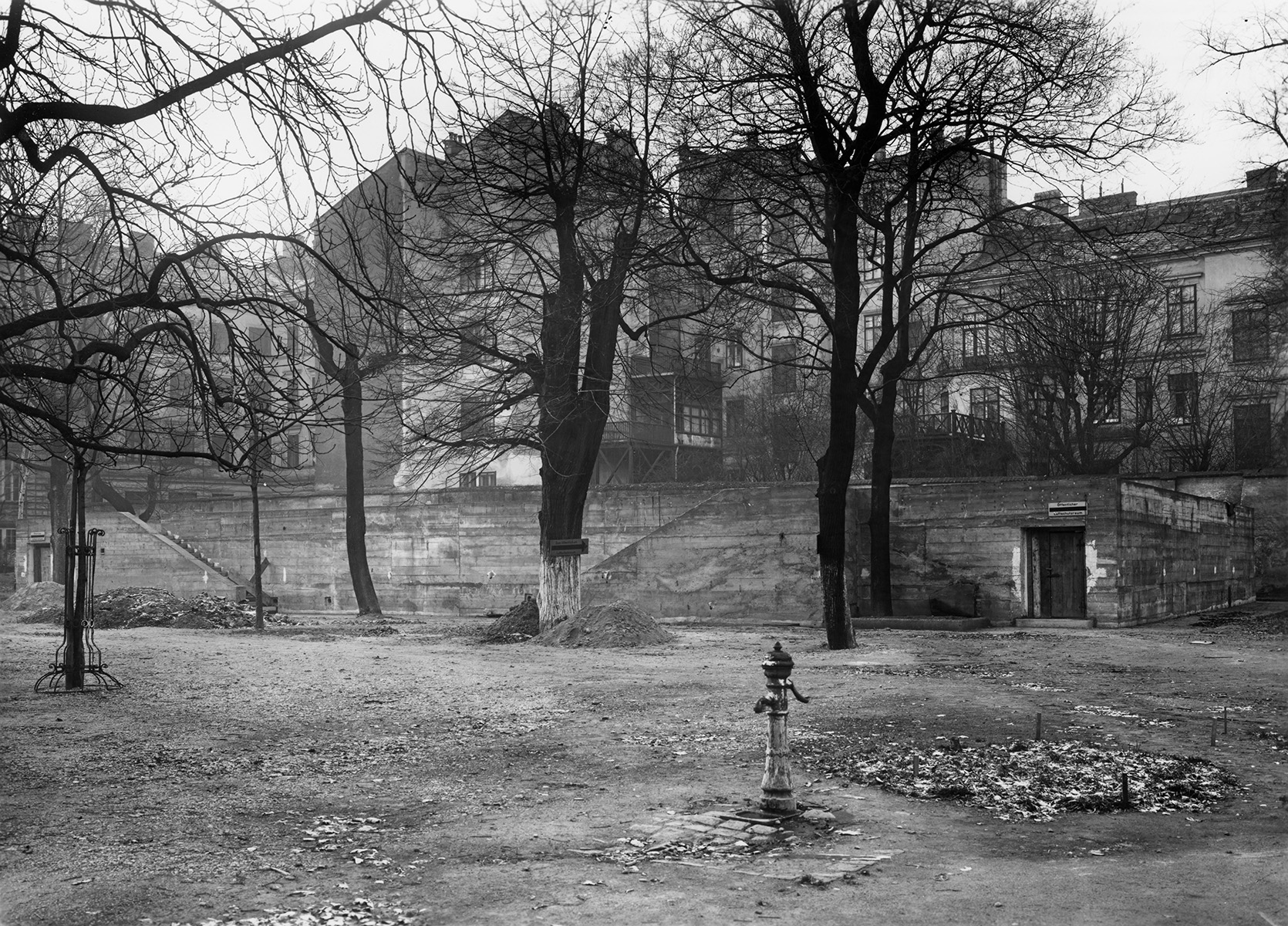
Work on an air-raid shelter in Schönbornpark, designed to accommodate up to 300 people, started in 1940 as part of the Bunker Construction Programme initiated by the Reich Aviation Minister and Commander-in-Chief of the Luftwaffe, Hermann Göring. The reinforced concrete shelter, built by the City Planning Office on municipal land, covered an area of approximately 800 square meters. The shelter was structurally identical to the ones in Arne-Karlsson-Park (9th district), at Schuhmeierplatz (16th district) and on Angerer Straße (21st district), designed with a half-story above ground (Ill. 3 and 4). Plans show attempts to incorporate the Schönbornpark shelter into the surrounding park grounds to make it invisible (Ill. 5). The structure had two entrances, two airlocks and two machine rooms. In addition, there were separate washing and toilet facilities for women and men, a medical room, as well as seating and sleeping areas in partitioned bunks for longer stays (Ill. 6).
Behaviour inside the shelter was subject to strict rules: open fires were prohibited, as they could impair air quality; smoking was also forbidden. Animals, with the exception of service and guide dogs, were not permitted. Those seeking shelter were required to bring their personal air-raid luggage, which contained important documents, money, valuables, necessary clothing and provisions.5


Nicole-Melanie Goll, Historian
Access to air-raid shelters was strictly controlled by the Nazi regime: anyone who was not part of the Volksgemeinschaft (‘people’s community’) as defined by the Nazi system was not allowed inside. Jews and forced labourers were denied access. As the war dragged on and the threat from the air grew, many people, driven by fear, wanted to be close to air-raid shelters even during periods without air-raid alerts, so they could be admitted quickly in an emergency. Admission to the shelters often took a long time, as they were frequently overcrowded. People remained in the shelters for hours; cut off from the ‘outside’, fear prevailed inside.

Nicole-Melanie Goll, Historian
Erwin Chloupek recalls Allied air-raids on Vienna (in German)

Hans Sindelar recounts his time on guard duty in a one-man bunker and remembers a direct bomb hit (in German)
Elisabeth Fickert-Sonnleithner describes how an air-raid alarm sounded and what action had to be taken (in German)
Franziska Kopta talks about the bombing of Vienna’s Nordbahnhof station(in German)
Helmut Niederhuber describes air raids on Vienna and the surrounding area (in German)
Helmut Niederhuber speaks about the Fischamend war memorial (in German)
Elfriede Neeb relates how Vienna’s 20th district was bombed (in German)
Susanne Wichtl elaborates on how war affects young people (in German)
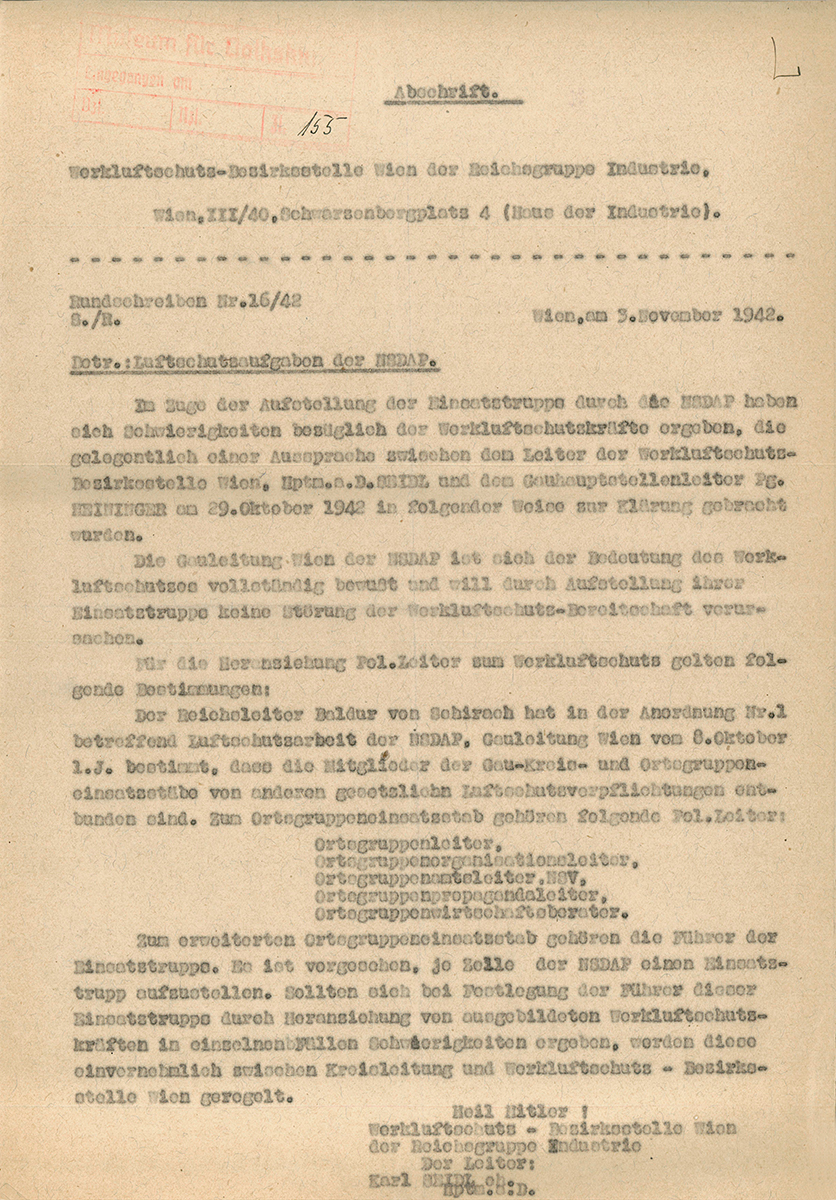
Starting in 1943, air-raid shelters became central places of Nazi rule. To prevent public sentiment from turning against the Nazi regime, the NSDAP disseminated propaganda-influenced interpretations of the air war and increased party presence.6 Party members controlled not only the air-raid shelters but also what happened before and after air raids (Ill. 7).

Georg Hoffmann, Director of the Museum of Military History (Heeresgeschichtliches Museum, HGM) in Vienna and Aerial Warfare Historian
The regime offered protection and victim support in exchange for compliant behaviour. Air-raid wardens, who served as coordinators of the shelters, became central figures in this exchange. Not only did they regulate access but they also monitored community- and regime-compliant behaviour. After air raids, Nazi organisations such as the Nationalsozialistische Volkswohlfahrt (National Socialist People’s Welfare) were present to provide immediate support to bombing victims and to those whose homes had been destroyed. Concentration camp prisoners were forced to clear the rubble of bombed-out buildings in the cities.

Nicole-Melanie Goll, Historian

Nicole-Melanie Goll, Historian
The traces of aerial warfare remain recognisable and visible throughout Vienna to this day – through the accounts of survivors, but also through the architectural remnants of air-raid cellars, bunkers and flak towers. They remain as visible and invisible memorials against war and fascism.
The exhibition “Kinder des Krieges – Aufwachsen zwischen 1938 und 1955” at the Museum Niederösterreich/Haus der Geschichte also deals with aerial warfare. The exhibition runs from 26 April 2025 through 17 January 2027 and includes an exhibition catalogue of the same name.
- Malte Thießen conducted an extensive study of the impact of the firestorm on remembrance and collective memory. See: Malte Thießen: Eingebrannt ins Gedächtnis. Hamburgs Gedenken an Luftkrieg und Kriegsende 1943 bis 2005. München 2007.
- See also: Markus Reisner: Bomben auf Wiener Neustadt. Die Zerstörung eines der wichtigsten Rüstungszentren des Deutschen Reiches – der Luftkrieg über der „Allzeit Getreuen“ von 1943 bis 1945. Berndorf 2014.
- (Translation); with this slogan (“Luftschutz ist Selbstschutz”), Nazi propaganda demanded active participation from their Volksgenossen.
- (Translation); original: n. n.: Sagt es allen! Aeußerliche Kennzeichnung von Luftschutzräumen. In: Neue Warte am Inn, 8.12.1943, p. 6.
- In July 1943, ‘Austrian’ daily newspapers began to indicate which documents were essential items of air-raid luggage and therefore had to be taken to air-raid shelters. Example: N. N.: Dokumente mit in den Luftschutzraum! In: Wiener Neustädter Zeitung, 3.7.1943, p. 4.
- See: Georg Hoffmann: Fliegerlynchjustiz. Gewalt gegen abgeschossene alliierte Flugzeugbesatzungen 1943 – 1945. Paderborn 2015, p. 108–126.