POV: Air-Raid Shelter and Museum after 1945
Remembering the Schönbornpark air-raid shelter
The Schönbornpark air-raid shelter, also referred to as bunker, could be a memorial. A persistently built provocation that reminds us of a fascist, murderous regime and a war that traumatised many – with lasting consequences. But it is not!
Buildings do not reveal their history on their own. They must be prompted, and we must approach their history with patience and a bit of creativity. Despite this hurdle, particularly ’contaminated’ buildings have increasingly become the focus of historical research in recent years.1 This may be because today – 80 years after the end of Nazi rule and World War Two –fewer and fewer people can share their first-hand experiences (‘end of contemporary witness accounts’). Since the 1980s, research examining the Nazi past has advanced, further investigating many different aspects and the long-term effects the years 1938 to 1945 have had. These changing prerequisites may have contributed to the realisation that infrastructure built during the Nazi era, as well as other human-made alterations in the landscape, can also bear witness. This idea brings new or different dimensions and perspectives into focus that contribute to a changed understanding.
Solid structures, such as the Schönbornpark shelter, open up a different plane of time – one that lasts longer than a human life. Like architectural testimonies from other centuries, they remain present and exist in the lives of several generations – albeit in the background and without their original function being recognisable. The past is therefore not truly past but continues to influence the present. This can be seen in the air-raid shelter in Schönbornpark, “for history does not simply stop when it is over. It is engrained in the built environment in buildings, street names and monuments [...]”2. (see Chapter 2: Becoming INvisible).
Air-raid shelter characteristics
The history of the Schönbornpark shelter is brittle and inaccessible. It is like the building itself: massiv unsichtbar – massively invisible. Growing fascination with air-raid shelters has led to the exploration of some shelters in Vienna in recent years, with guided tours being offered through the structures. But the focus has largely been on the Second World War, although air-raid shelters tell about much more than (aerial) warfare and civil defence.
With the end of World War Two, the Schönbornpark shelter – like many other structures erected for the war – lost its original function. After 1945, it was initially an obvious and manifest reminder of the immediate, violent past in a war-torn environment. Unlike other buildings such as administrative or government buildings, which were relatively seamlessly used again, the Schönbornpark shelter was not pragmatically reused due to the specific function it had served (protection of civilians from air raids) and due to the presence of Allied troops in Austria until 1955. It was not ‘intentionally’ reused; i.e., it was not dedicated to a specific purpose. Nor was it ‘intentionally’ left unused, because the Nazi regime’s ideological and propagandistic framing of the structure and the committed war crimes would have made further use difficult.
Until 2023, the shelter served as storage (see Chapter 3: Who Does the Shelter Belong to?). Largely separate from this, the exterior, especially the roof, was used (see Chapter 2: Becoming INvisible). It even became the scene of a dispute between different interest groups in the 1980s, including the administration of Vienna’s 8th district, Vienna City Administration, citizen initiatives and Volkskundemuseum (see Chapter 3: The ‘Josefstadt Bunker War’).
How to remember a building?
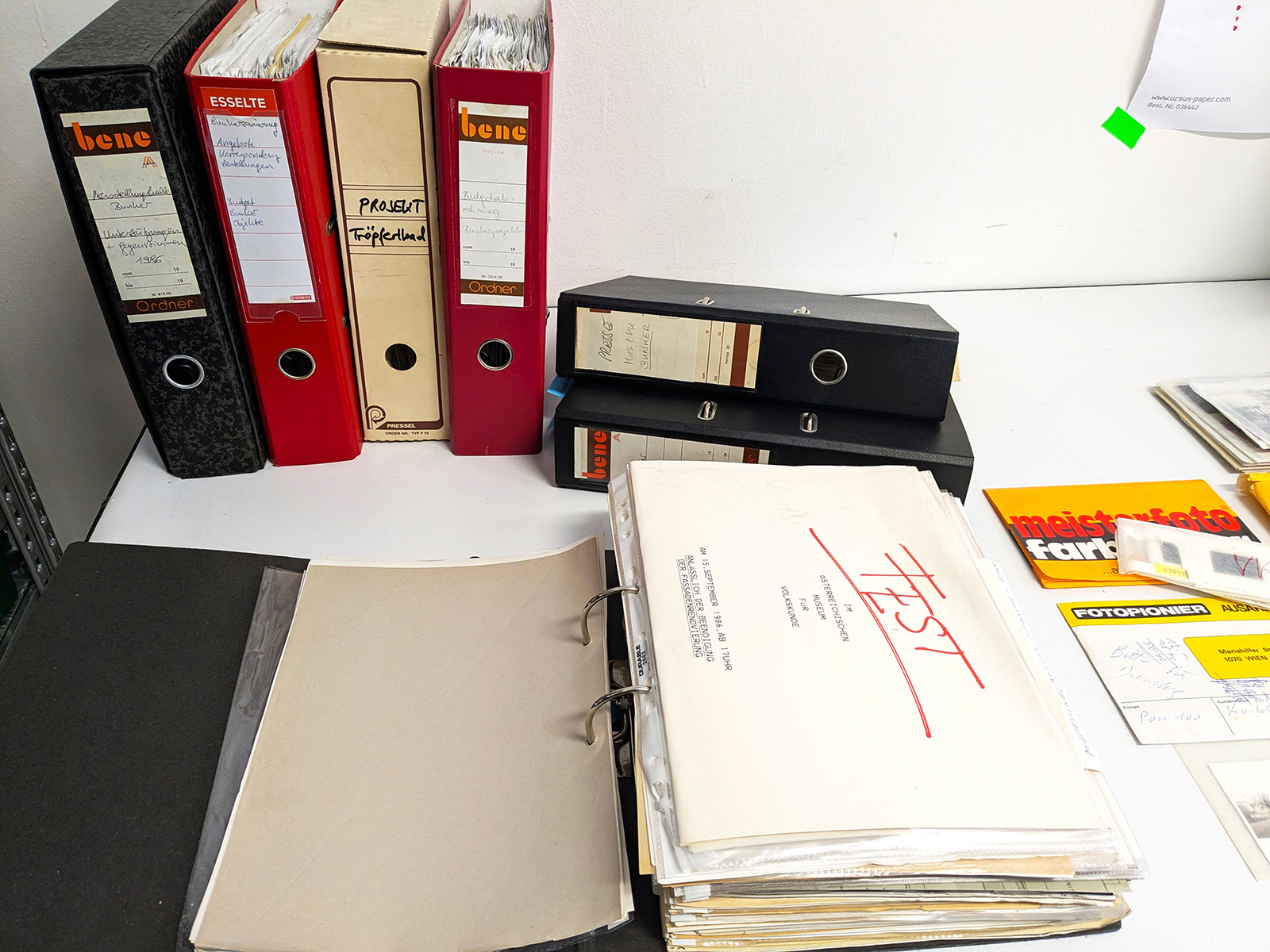
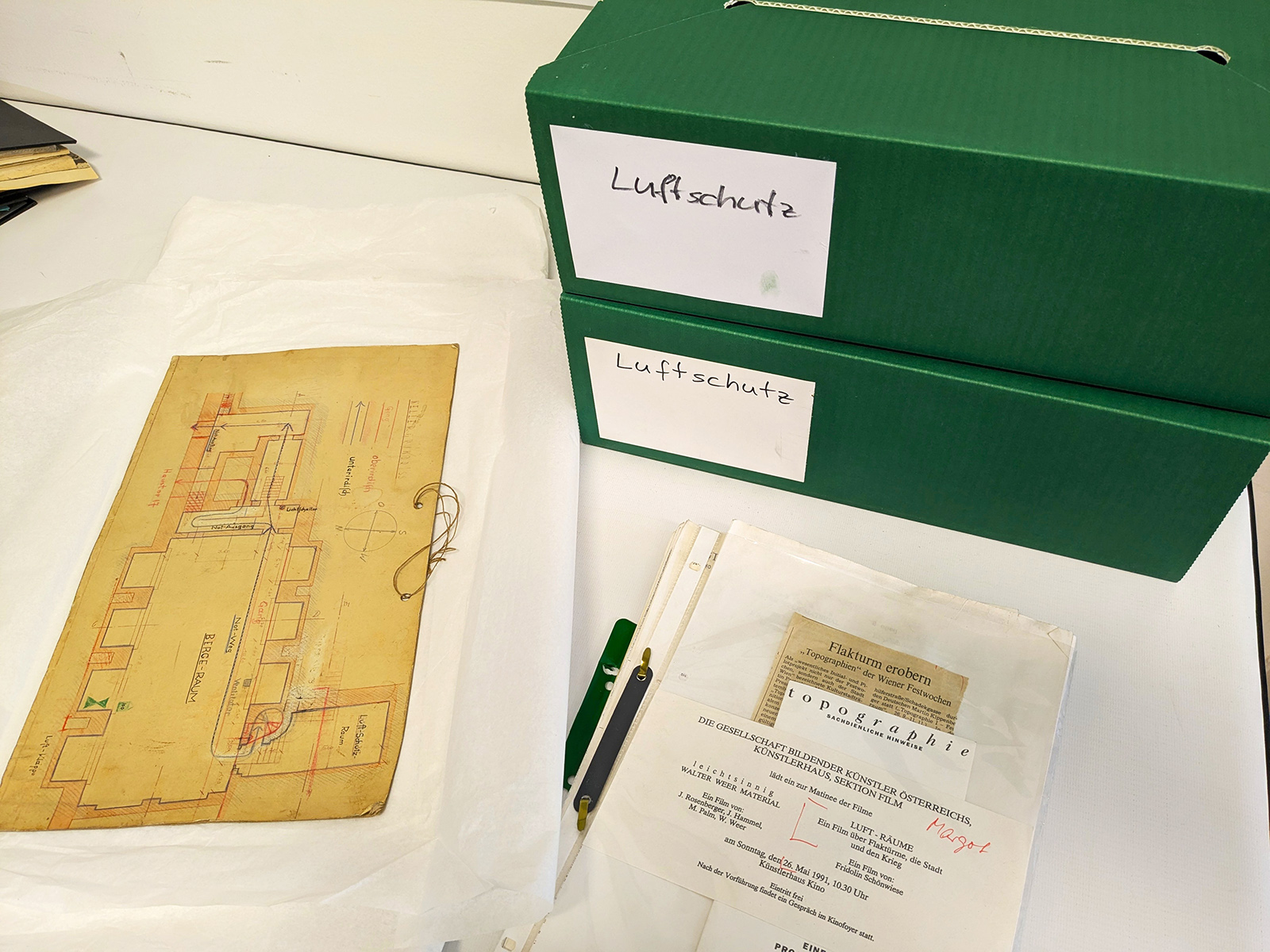
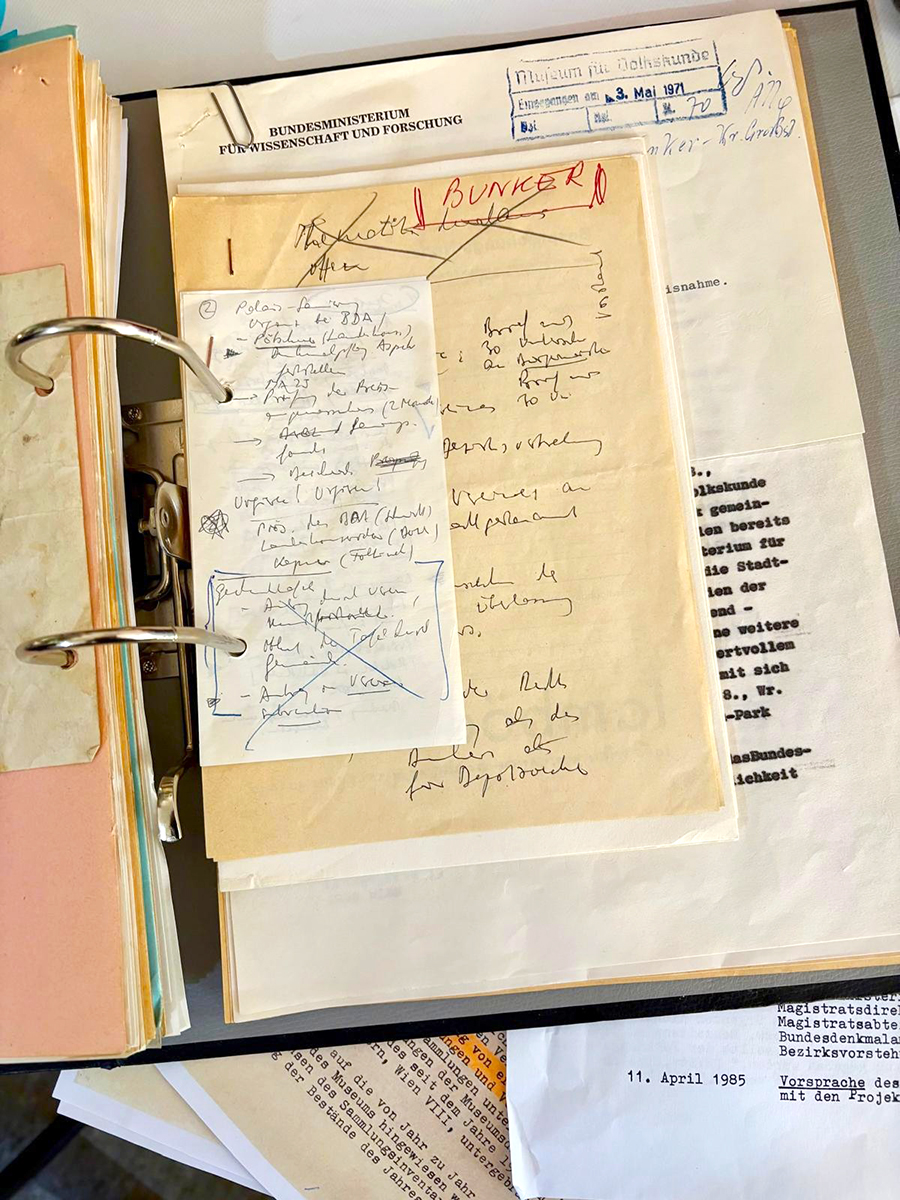
Despite some preliminary work on existing records, the archival materials (correspondence, plans, photographs, newspaper clippings, notes, etc.) related to air-raid protection and the Schönbornpark shelter remain largely unprocessed. Our approach is based on different materials and methods so as to gain as broad a perspective as possible on the history of the air-raid shelter: in addition to literature on both subject and methodology, we drew on three further sources of information. It was important to us to stay as close as possible to the structure and its long-standing connection with Volkskundemuseum. As a result, the materials from the Volkskundemuseum archive were both the starting point and the central focus of our work on the building’s biography, spanning a total of 85 years (Ill. 1 to 4).
The findings derived from the archival materials are supplemented and contextualised by several experts advising on specific aspects of the historical context. Additionally, interviews with contemporary witnesses provide personal insights into past events. These accounts were created as part of the MenschenLeben oral history project realised by the Austrian Media Library (Österreichische Mediathek), where they are stored.

Visit the online exhibition of Österreichische Mediathek to learn more about oral history methodology from historian Gerhard Jagschitz.
- Cf., for example, Richard Hufschmied et al. (eds.): ErinnerungsORTE weiter denken. In Memoriam Heidemarie Uhl. Wien, 2023; Ingrid Böhler et al. (eds.): Ver/störende Orte. Zum Umgang mit NS-kontaminierten Gebäuden. Berlin, 2024.
- (Translation); original quote: “[d]enn Geschichte hört ja nicht einfach auf, wenn sie vorbei ist. Sie geht in Gebäuden, Straßennamen und Denkmälern in die gebaute Umwelt ein […]“; cf. Aleida Assmann: Vergangenheit, die nicht vergeht. Gespaltene Gesellschaften und gegensätzliche Narrative. Wiener Vorlesungen, Band 221. Wien 2023, p. 51.