Becoming INvisible
Trauma as a past that never passes
“The formula of the past that never passes is, at the same time, a convenient definition of ‘trauma’”1, writes cultural scientist Aleida Assmann (*1947), who has researched processes of remembering and forgetting for decades.
Almost symbolically, the Schönbornpark air-raid shelter stands for personal and societal trauma, brought about by wars and the associated multifaceted violence. A building so massive that it could hardly be removed; it was destined to continue to exist.
The archives of Volkskundemuseum Wien contain several references to the “former bunker”. But a bunker will always be a bunker – even if it has not been perceived as what it used to be for many years, probably even decades: a building of war and violence.
As the war ended, the Schönbornpark shelter became both uncomfortable and sought-after. This is particularly evident in the immediate post-war period up to 1948 when the entire park was in a transitional phase – between the aftermath of the war and its first new uses.

Lukas Schretter, Historian and European Ethnologist
Lukas Schretter, Historian and European Ethnologist
Lukas Schretter, Historian and European Ethnologist
Lukas Schretter, Historian and European Ethnologist
City Hall Correspondence from 22 January 1948, entitled “The Work of the Demining Service”, stated that “the most dangerous legacy that the war has left our city is the large quantities of all kinds of explosives, which, originating from immediate combat operations or air raids, continue to cause harm.”2 In 1947, the Demining Service of the General Directorate for Public Safety in Vienna “defused and transported to the Bombachgraben explosion site near Neuwaldegg 338,816 kilos of bombs, mines, anti-aircraft and anti-tank ammunition, hand grenades, Panzerfäuste and other explosives”.3 By April 1948, Vienna City Administration had “restored 300,000 m² of area”, including Anzengruberpark, Modenapark, Hamerlingpark, Arne-Karlsson-Park and Schönbornpark – “more than 1,000 avenue trees were replanted, shrapnel trenches and 17 fire-fighting ponds were removed”4.
Excerpt from the oral history interview with Elisabeth Fickert-Sonnleithner (in German)


After two Soviet soldiers who had died in the Soviet military hospital5 temporarily set up in the building of Volkskundemuseum (Schönborn Garden Palace) and who had been buried in Schönbornpark were reburied at the Central Cemetery, the park could gradually become a leisure and recreation area again. The most massive memorial – the air-raid shelter – had become obsolete, no longer fulfilling its function. Although the purpose of the building remained unclear for many years and the administrative responsibilities still had to be determined, various protagonists began to express interest in this unavoidable building in Vienna’s densely built 8th district. Different organisations reported space requirements and storage needs. Volkskundemuseum Wien, which had hoped to be able to move to another, larger building under the Nazi regime, also kept a close eye on the nearby building and its uses.
Post-war use of military buildings and civil defence structures in Vienna
Military and civil defence structures constructed by the Nazi regime in Vienna were no longer needed after the end of the Second World War. Air-raid shelters and the three flak bunker pairs had suddenly been deprived of their functionality.
Unlike most of the underground shelter systems, the six flak bunkers (also known as flak towers) in Vienna continue to shape the cityscape to this day, being visible from afar. Unlike in Berlin and other places, the Allies did not demolish the towers located amidst the densely built urban environment of Vienna.6
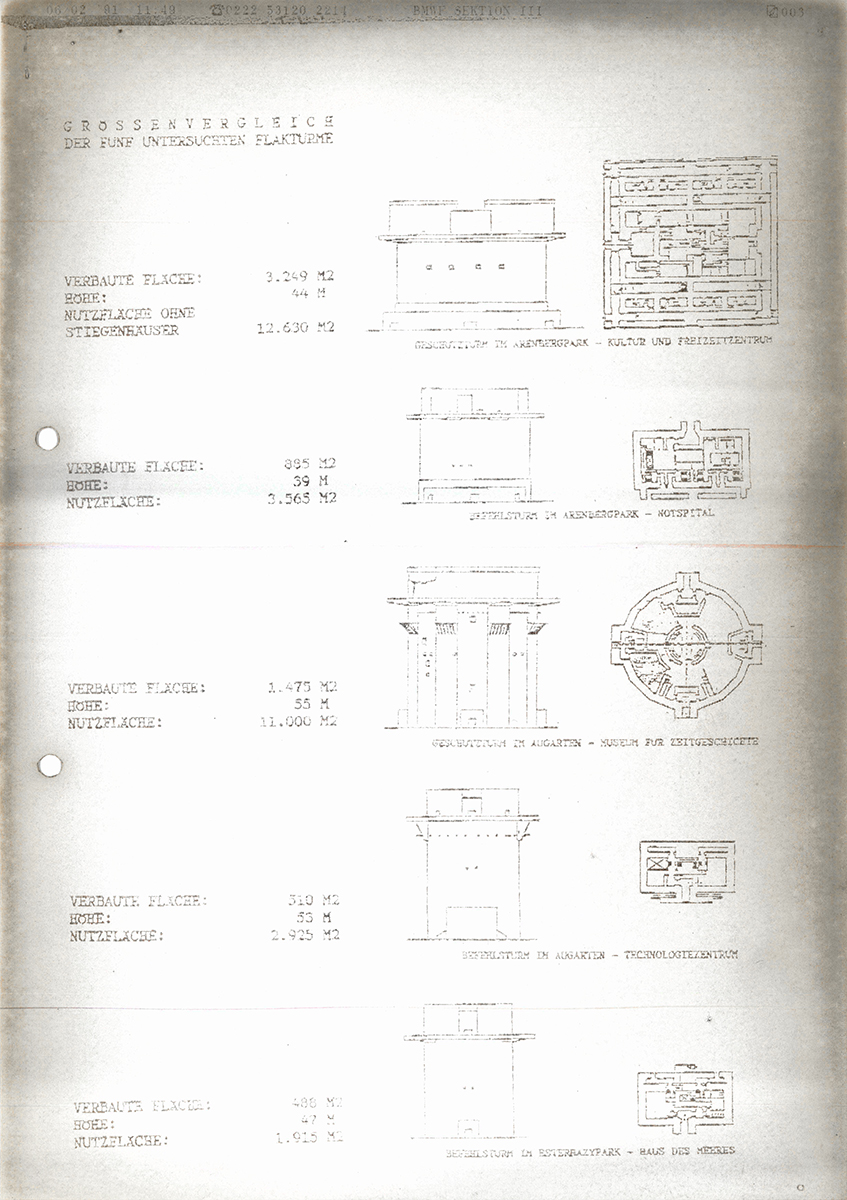
Between 1945 and 1955, the towers were mainly used by Allied troops.7 After their withdrawal, the question arose as to what should be done with these solid and (still) widely visible buildings. The Stiftskaserne tower in the 7th district has been used by the Austrian Armed Forces since 1955.8 The associated command tower in Esterházypark (5th district) was converted into the Haus des Meeres (HDM) in 1957.9
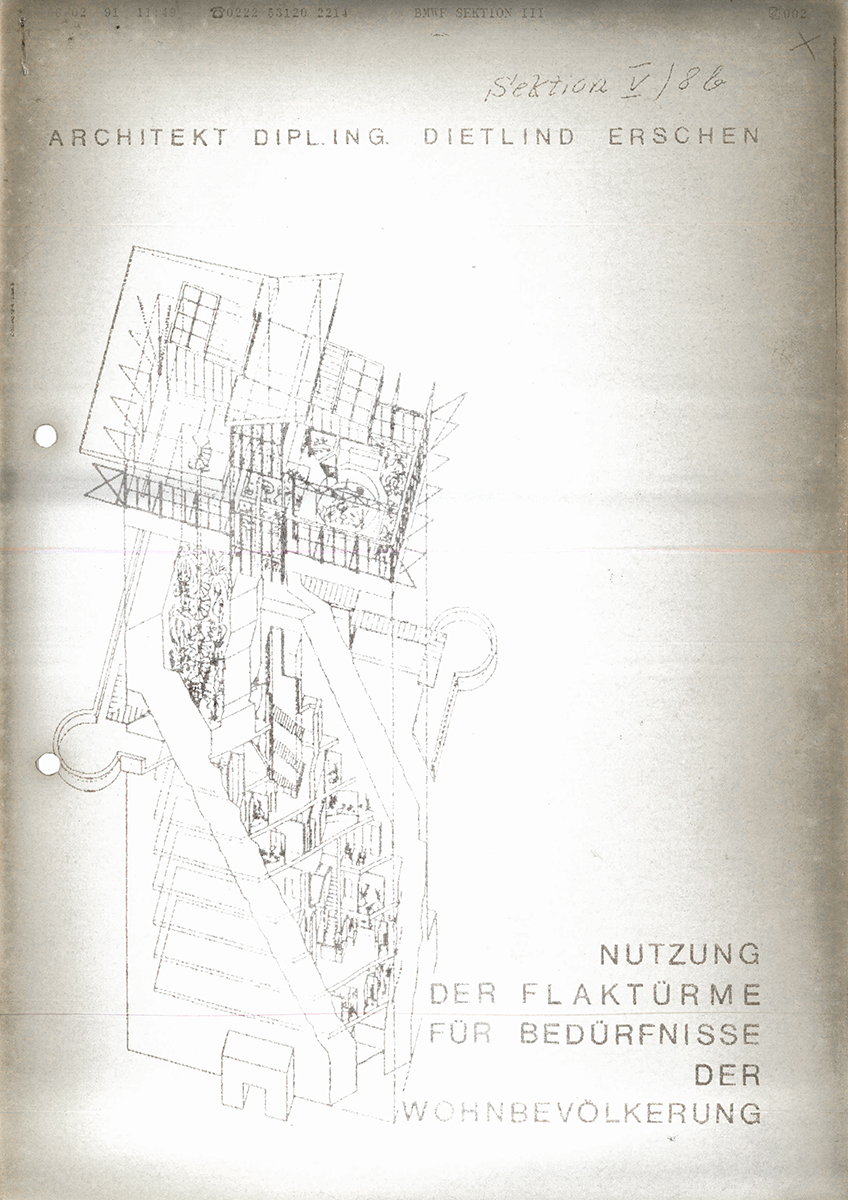
Since the late 1950s, there have been several public discussions on plans (Ill. 1) about what to do with the tower pair in Augarten (2nd district) and Arenbergpark (3rd district).10 The Arenbergpark tower has been used as a museum depot since 1991 – first, by the Federal Museums11 and, since 1995, by the Museum of Applied Arts (MAK)12. Volkskundemuseum, too, stored objects there between 1991 and 1993.13 It is not uncommon that military and civil defence structures in Vienna are used as storage facilities for art and cultural assets. In addition to Volkskundemuseum and the Museum of Applied Arts, the Austrian Gallery Belvedere also uses a similar structure – a deep bunker located underneath a park – as an object depot.14 Before Volkskundemuseum began to use it, the structure in Schönbornpark was used by municipal departments of the Vienna City Administration as a storage facility for archives and books between 1947 and 1978.15
Another option was to use the structures as foundations for new buildings (see Chapter 3: Who Does the Shelter Belong to?). Plans existed between 1958 and 1962 for five of the six flak towers in Vienna to be integrated as bases into high-rise buildings.16 In 1961, the Volkshochschule (adult education centre) Favoriten building at Arthaberplatz (10th district) was constructed on top of the site’s deep bunker.17
To learn more about where air-raid shelters were built in Vienna and what purpose they serve today, please refer to the knowledge platform Wien Geschichte Wiki.
Georg Hoffmann, Director of the Museum of Military History (Heeresgeschichtliches Museum, HGM) in Vienna and Aerial Warfare Historian
From civil defence to object protection
Volkskundemuseum has existed without interruption ever since it was founded in 1895. The organisation that owns it – Verein für Volkskunde (Ethnographic Society) has never dissolved either (not even under the Nazi regime). In 1945, several people were dismissed from the museum due to their connections to and scientific and ideological involvement in the Nazi system as part of the initial denazification process. The then Director, Arthur Haberlandt, (1889–1964) was dismissed, as were other employees who had been part of the Nazi system. Under the new Director, Leopold Schmidt (1912–1981), the museum was renamed in Österreichisches Museum für Volkskunde. With the new emphasis on ‘Austrian’, the museum met the expectations and requirements of the Allies, who not only urged for Austrian neutrality but also wanted to see the narratives and dogmas of National Socialism pushed back by a strengthened Austrian consciousness.
Outlining Austria as ‘harmless’ (legitimised by the Moscow Declaration of 1943, which described Austria as the ‘first victim’ of Nazi Germany) meant that the country now considered and presented itself primarily as a cultural nation.
It is perhaps not surprising that the Schönbornpark air-raid shelter, as well as many other war buildings and protective structures, were no longer used as military or civil defence buildings after 1945. Their protective function had shifted from people to art and cultural assets, amongst others.
Becoming invisible: the external transformation of the Schönbornpark air-raid shelter
Why is it that many people do not discern the Schönbornpark air-raid shelter anymore today? This section traces how such a massive and solid building disappeared before our very eyes.
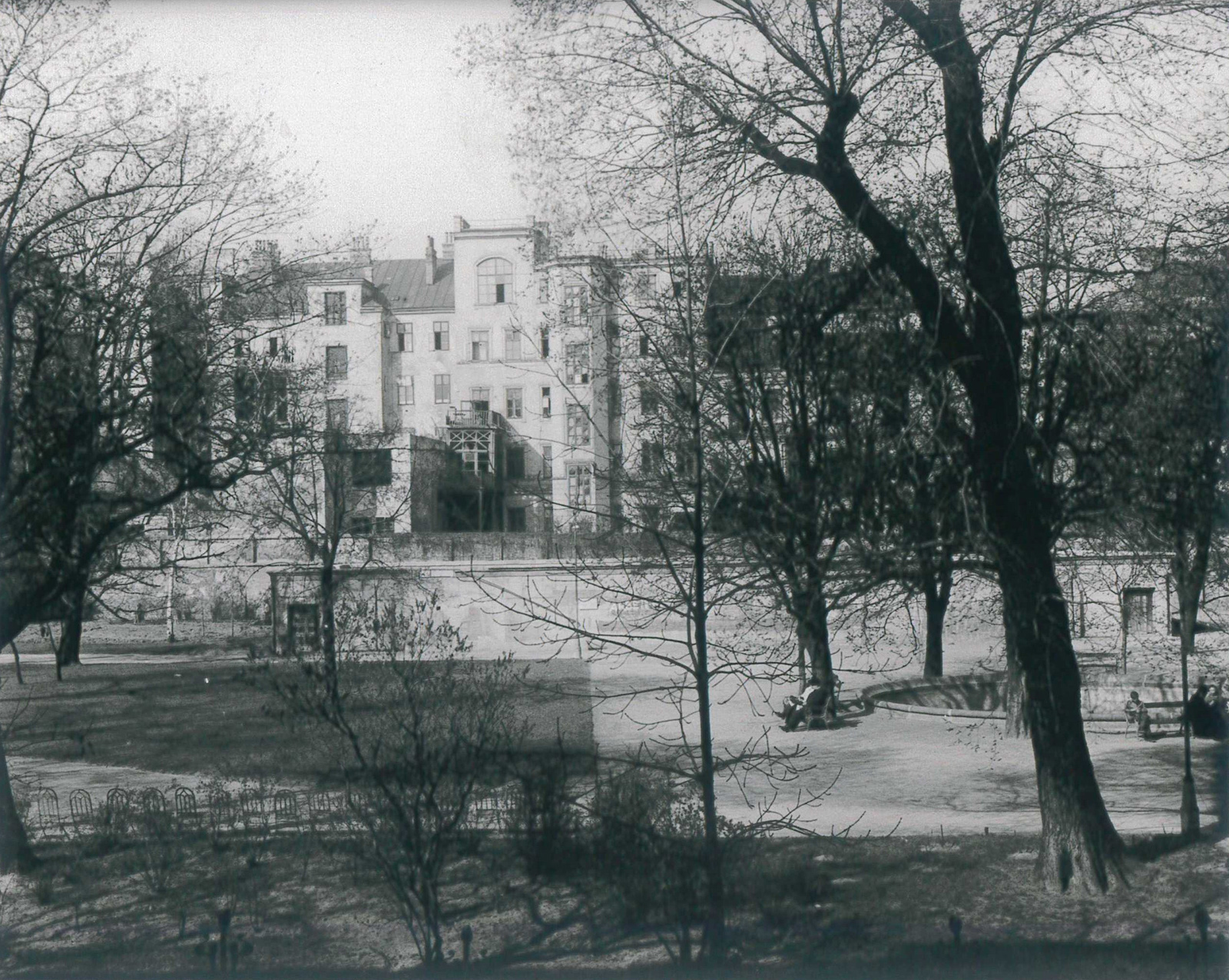
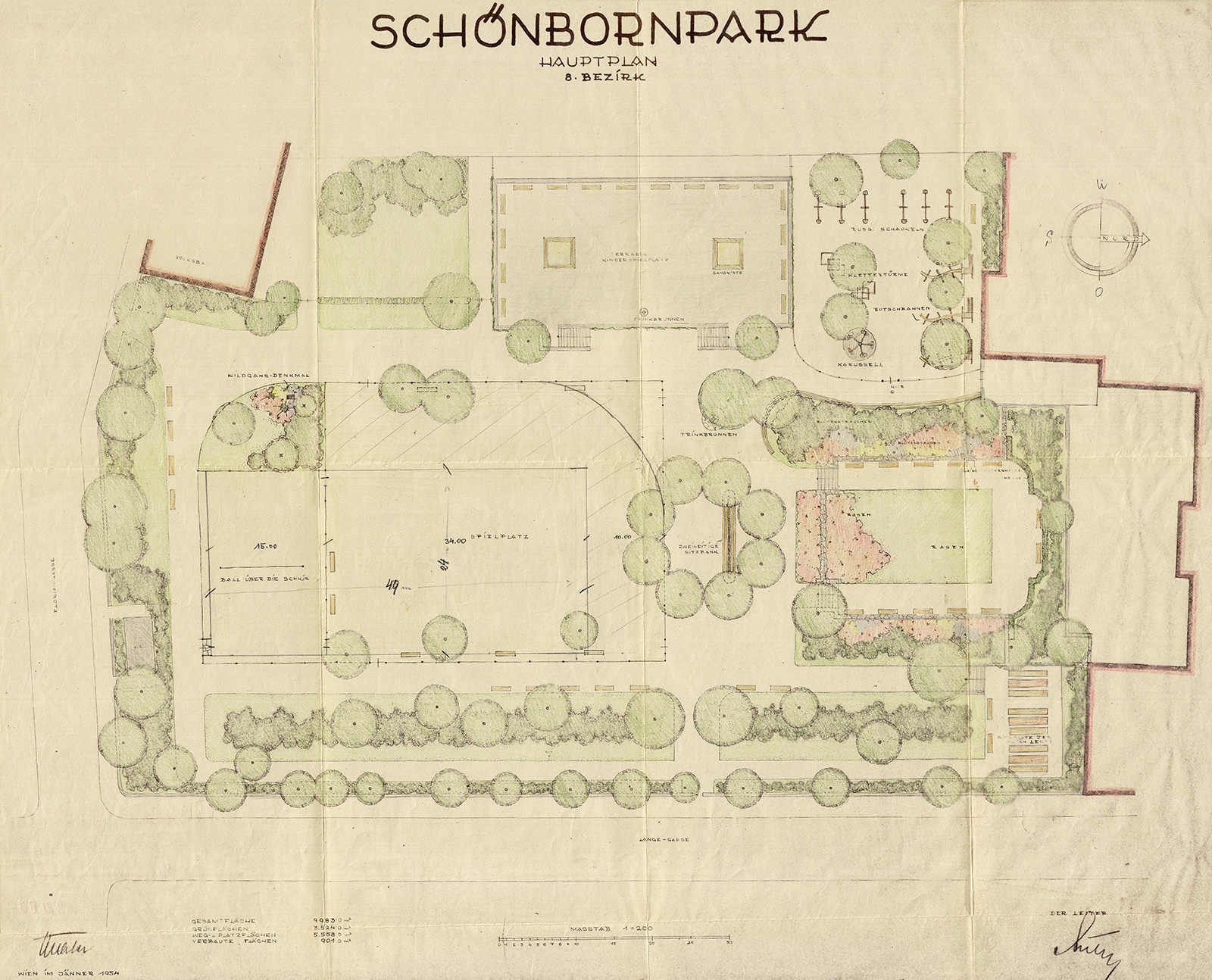
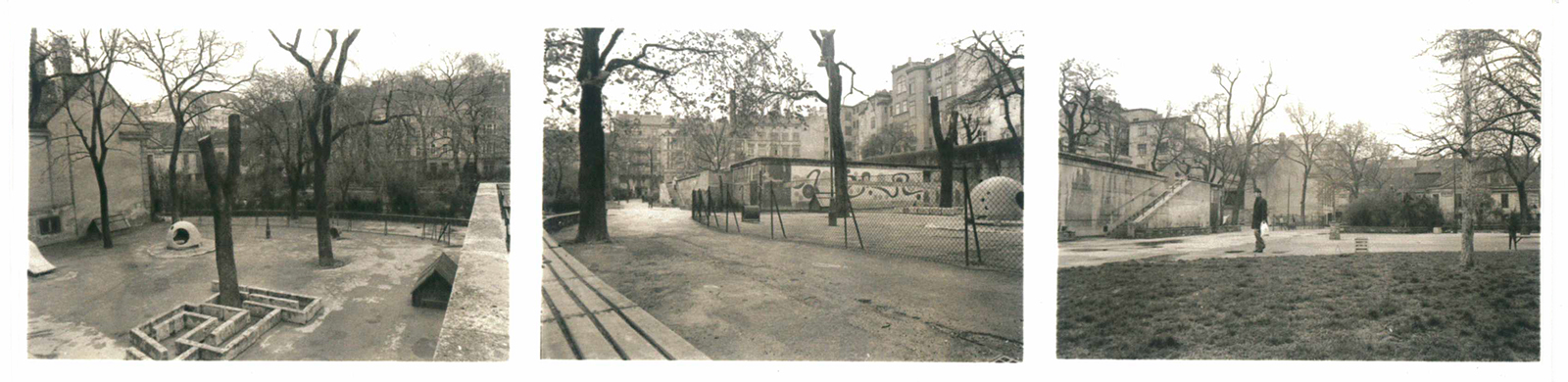
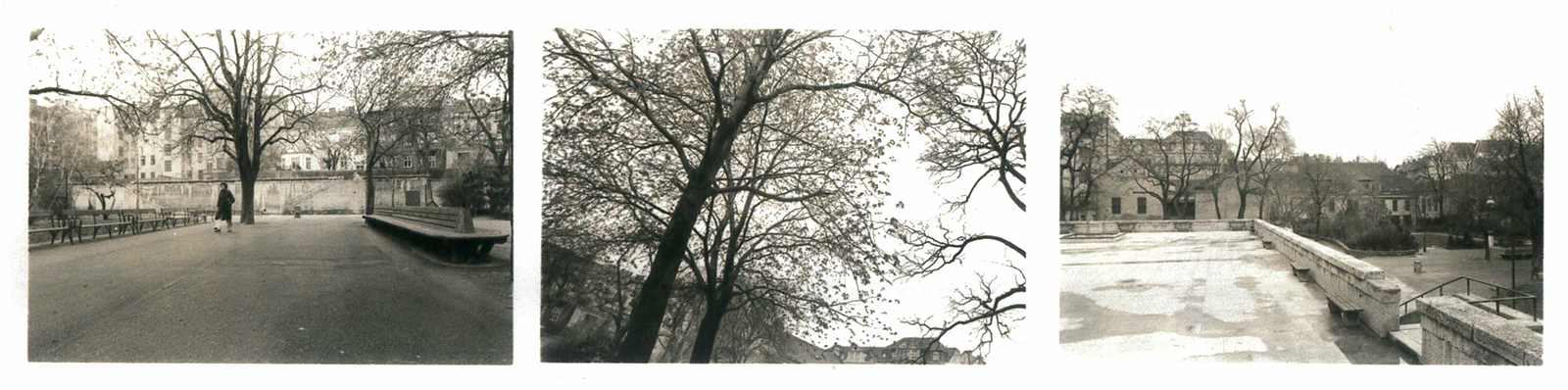
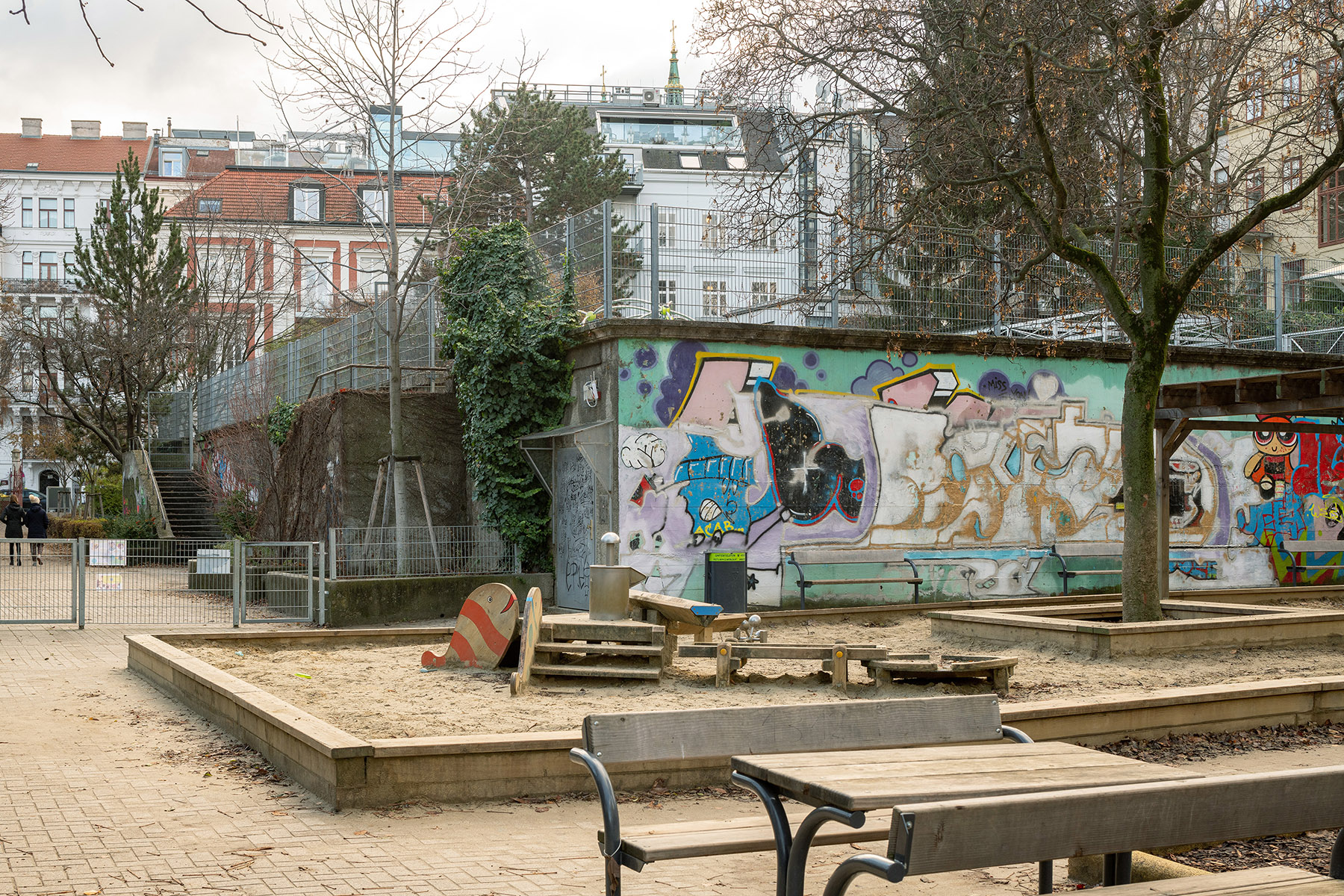
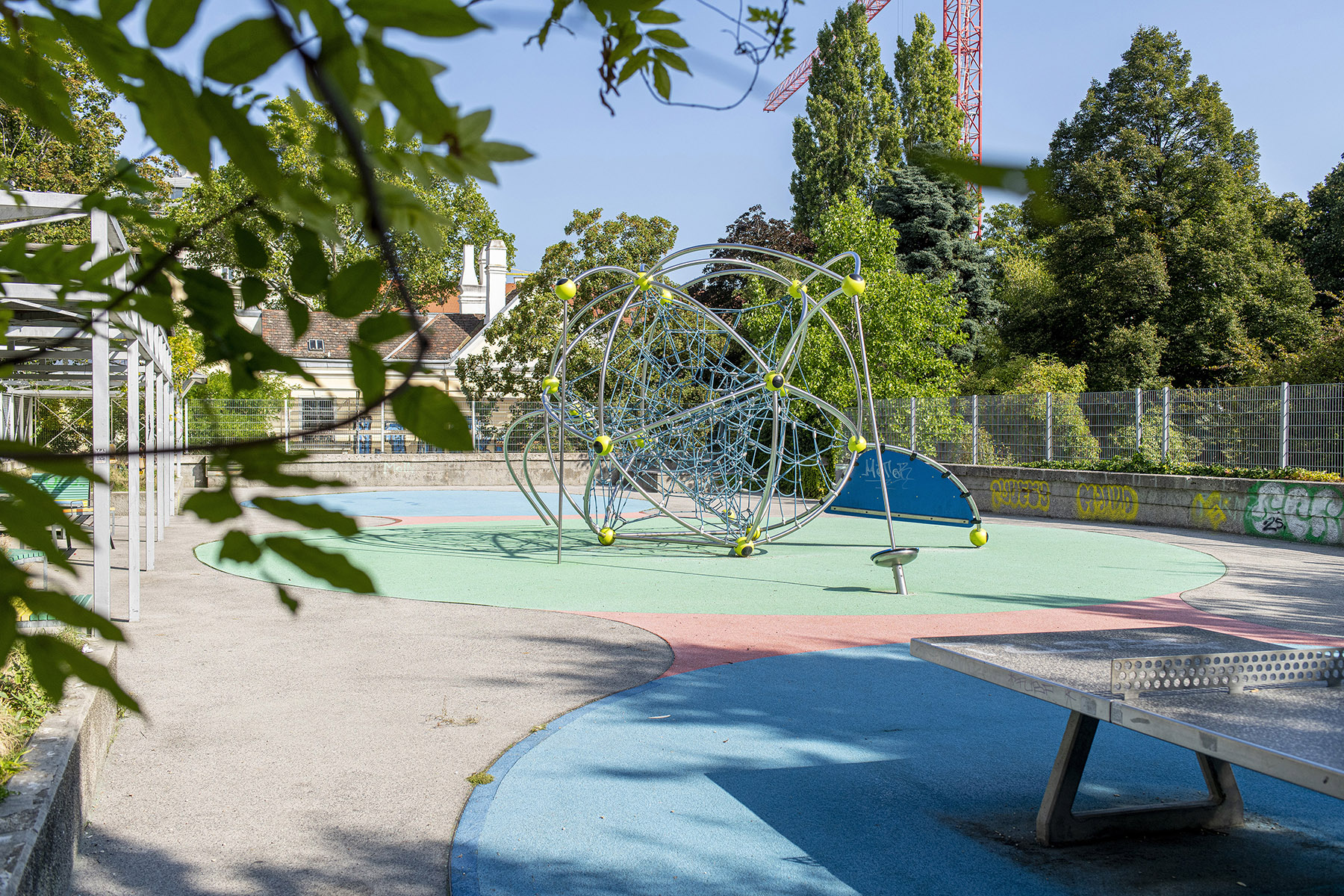
In 1947, the roof of the shelter was converted into children’s playground.18 In fact, the area has primarily been designated as such since then. The parapet was most likely installed when the playground was established. In any case, it is captured in photos taken on 8 April 1949 (Ill. 2). On the main plan of 195419 (Ill. 3), the flat roof of the shelter is referred to as a “terrace children’s playground”. According to this plan, there were 16 benches, two sandboxes and a drinking fountain, and three of the four outer walls had greenery on them.
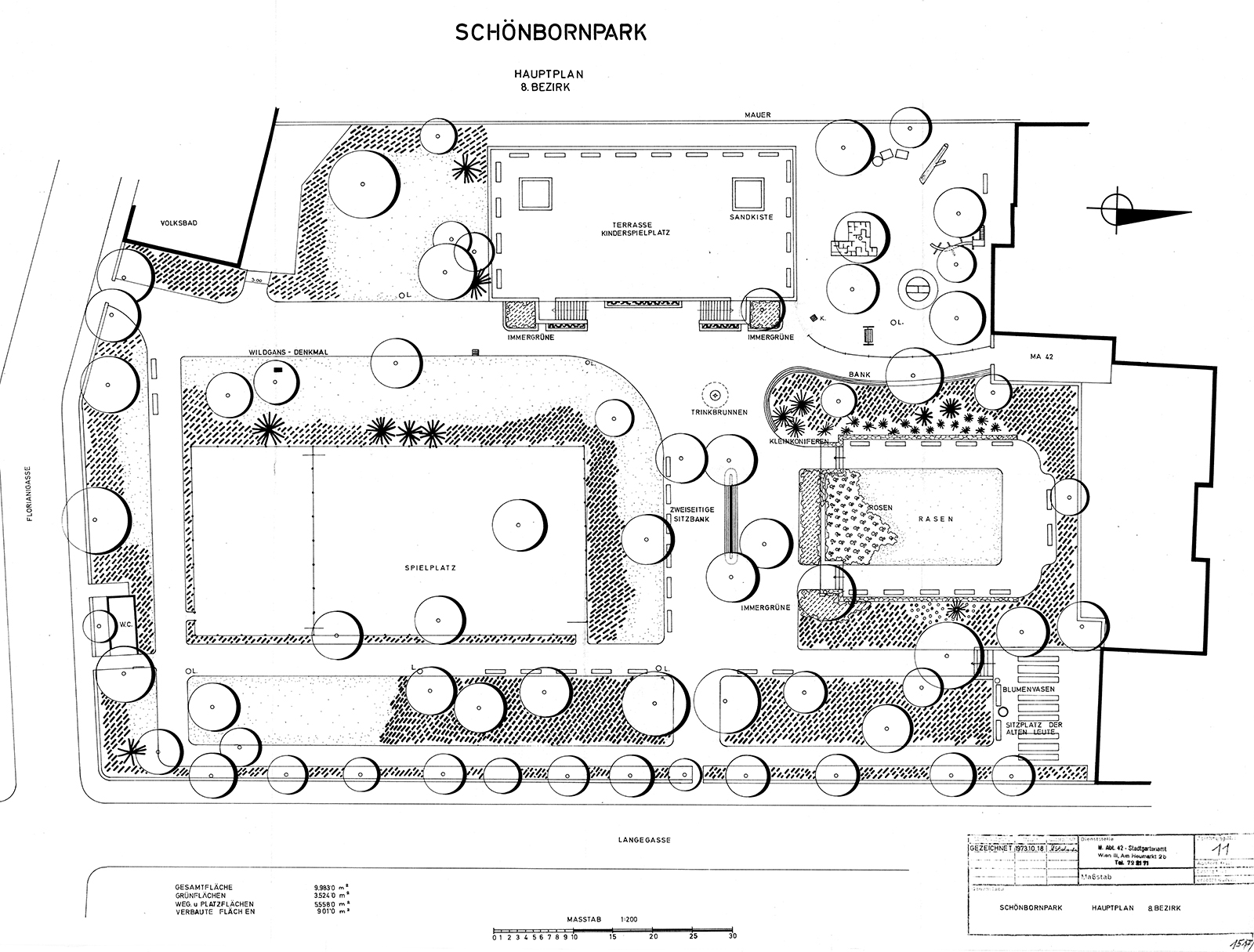
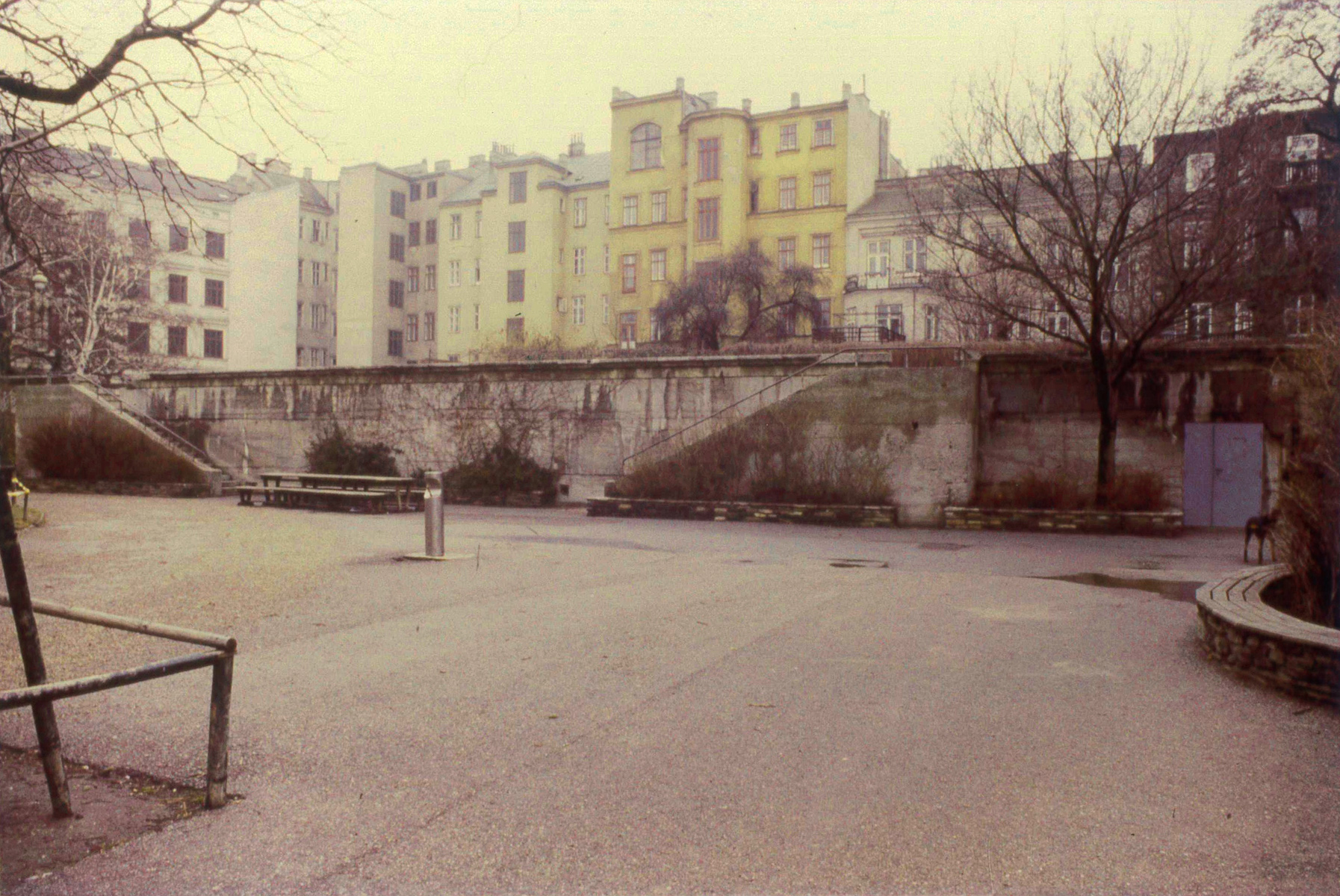
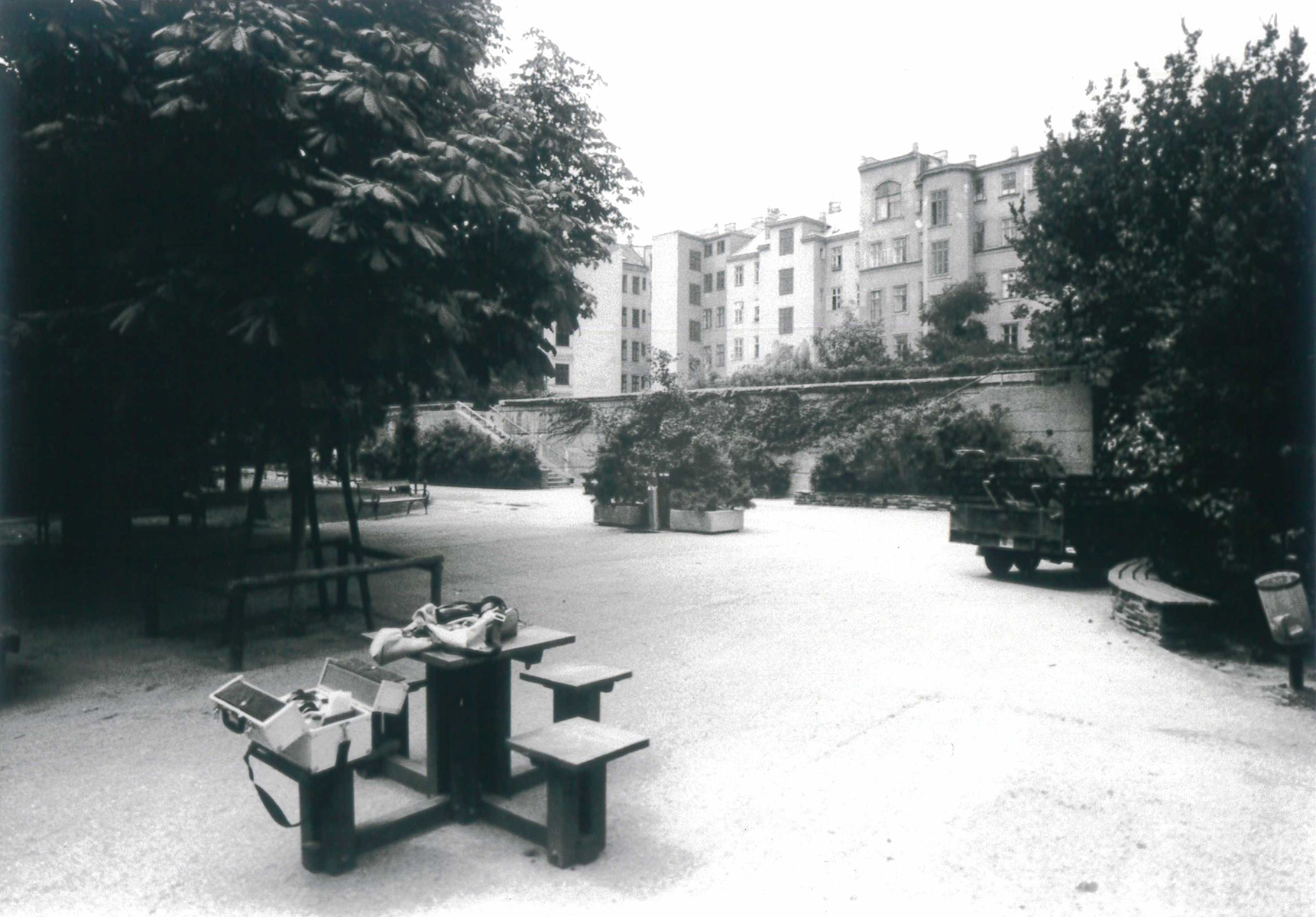
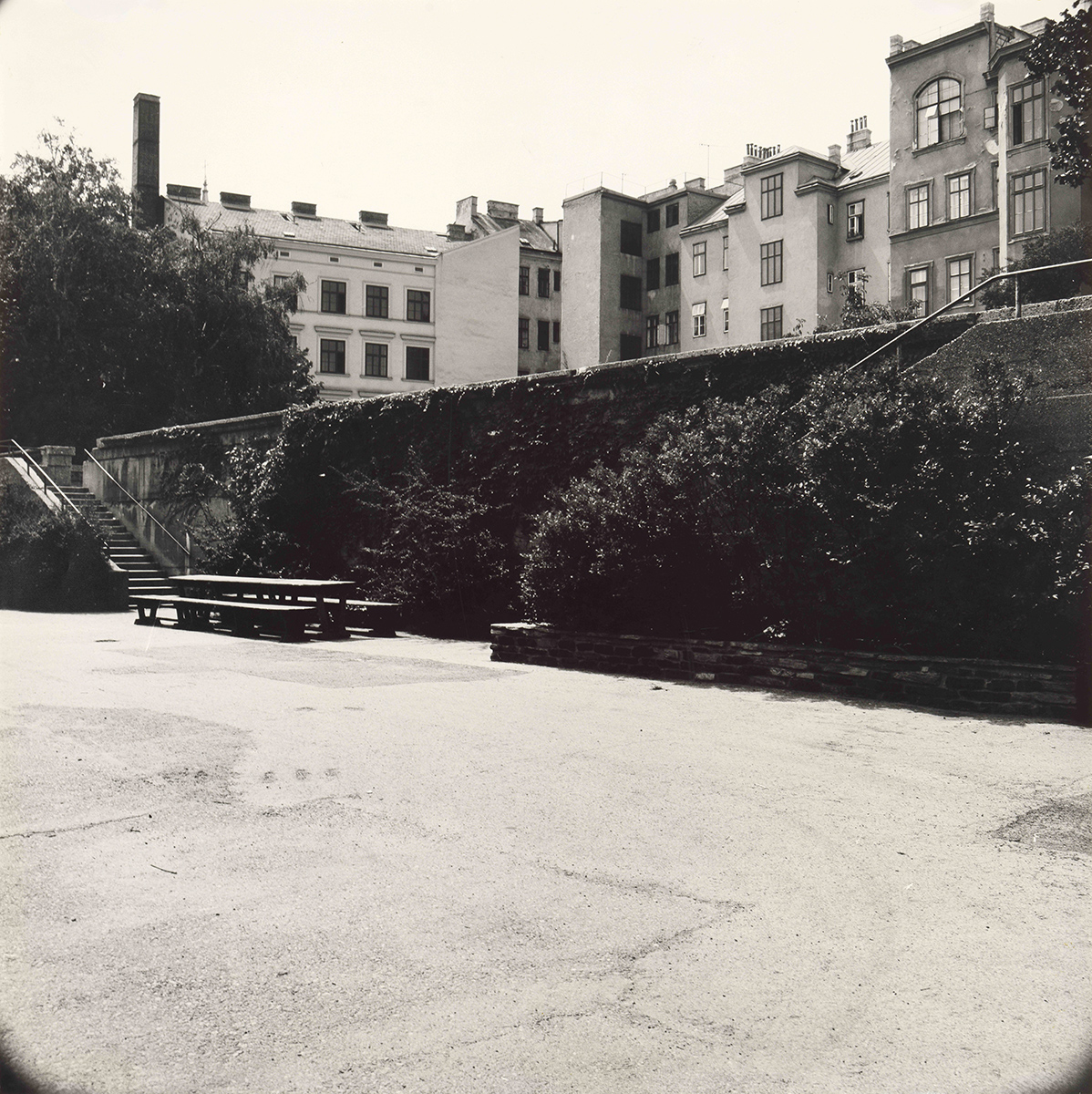
21 years later, the main plan of 197320 (Ill. 4) also identifies the area as a “terrace children’s playground” and includes the 16 benches and two sandboxes. Large stone planters, still there today, were placed in front of, next to and between the stairs (Ill. 5, 6 and 7). The outer walls were probably not (or no longer) fully covered by plants by the early 1970s. After 1973, the outer walls were plastered over; and by 1978, the shelter looked bare and largely bleak from the outside (Ill. 8 and 9).21
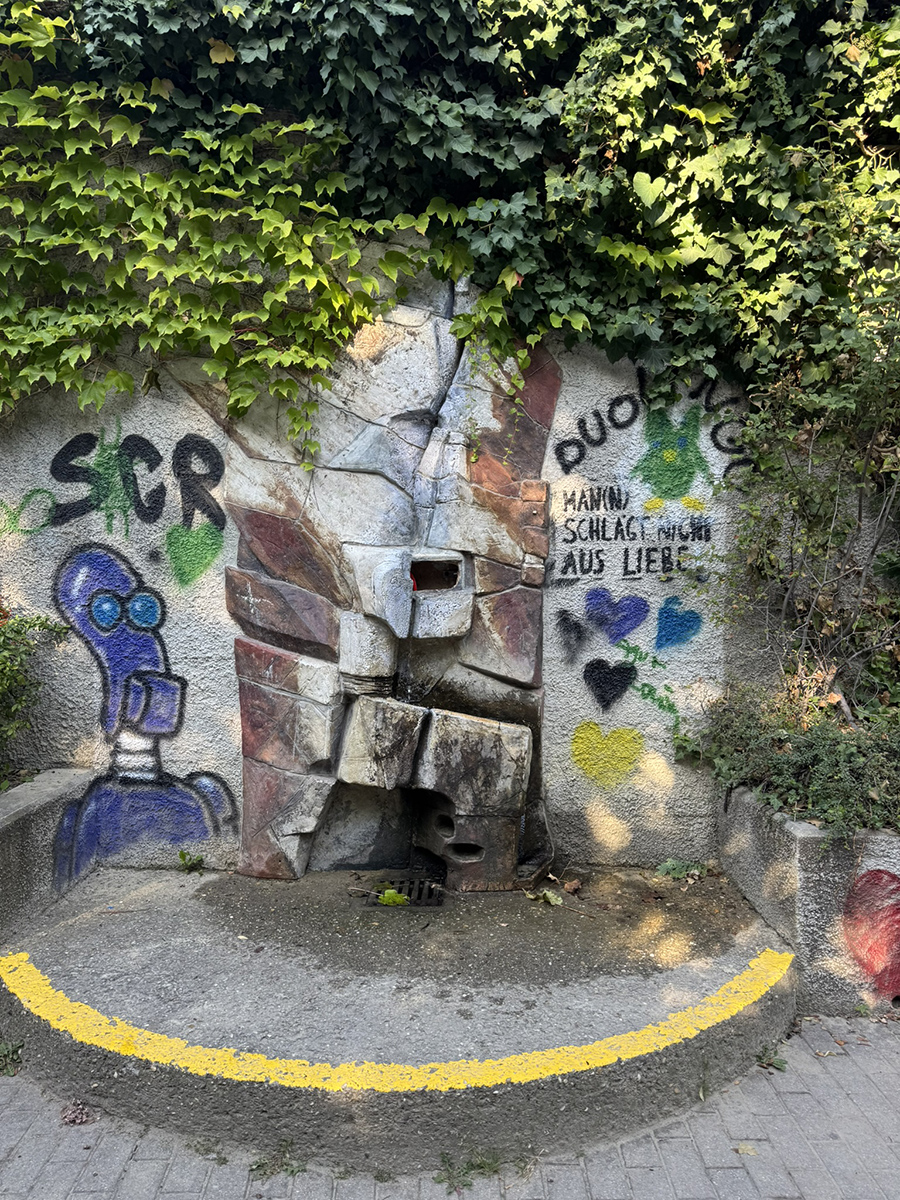
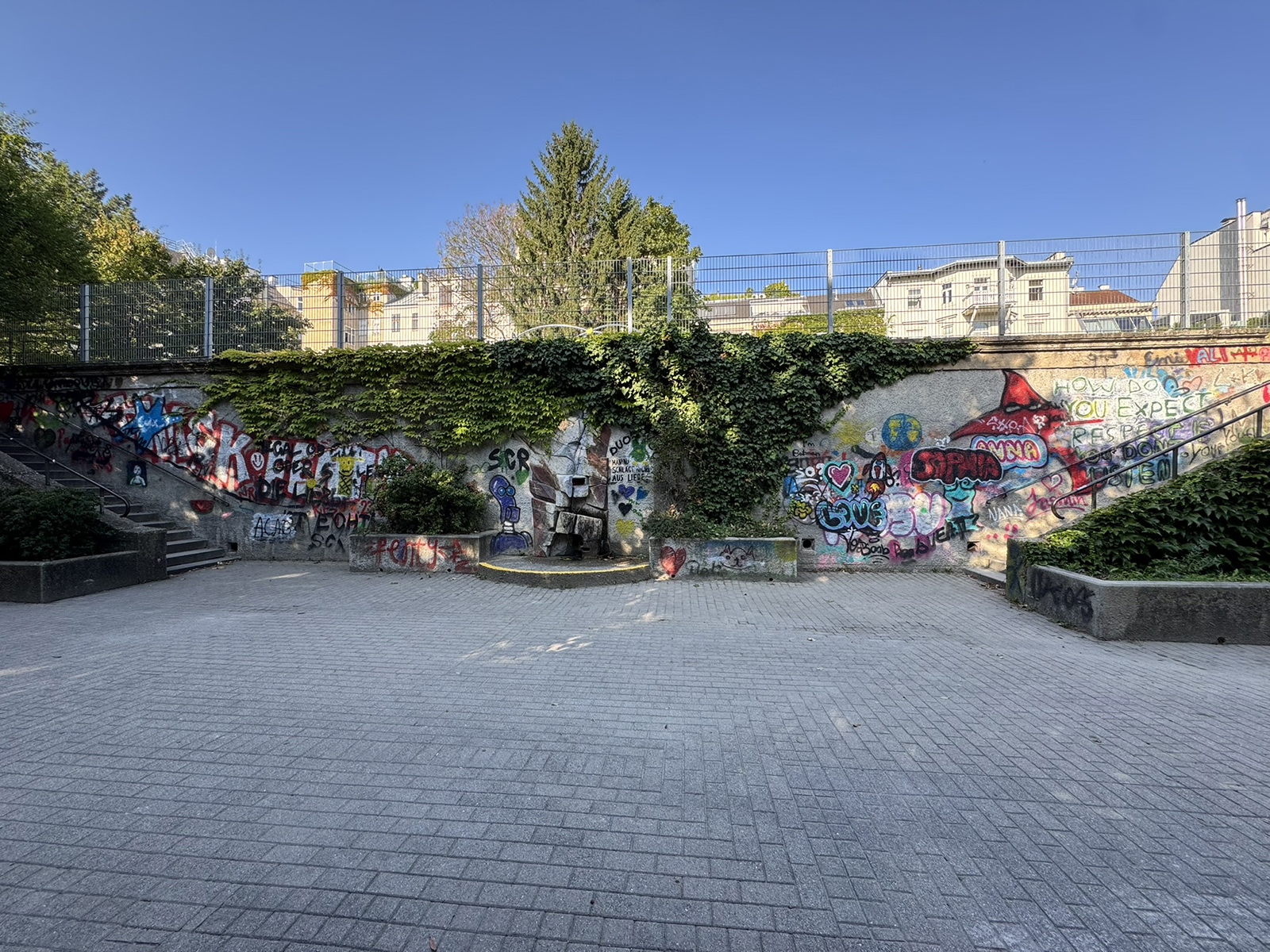
In 1987, the drinking fountain, which still exists today, and its mosaic, created by artists Johannes (1947–2021) and Charlotte Seidl (*1948), were installed on the façade between the stairs (Ill. 10).22
Because the air-raid shelter was consistently labelled as a terrace and playground in official plans of the park and because minor changes were made to and around the façade, the air-raid shelter gradually disappeared and became almost seamlessly integrated into the park landscape. Today, in addition to plants and the drinking fountain with its mosaic, it is also covered with graffiti (Ill. 11 and 12). The flat roof is still used as a playground (Ill. 13).
The exhibition entitled Controlled Freedom. The Allied in Vienna – Culture Policy 1945–1955 (Kontrollierte Freiheit. Die Alliierten in Wien – Kulturpolitik 1945–1955) at Wien Museum that ran from 10 April to 7 September 2025 focused on another aspect of the post-war period. A catalogue of the same name accompanying the exhibition was published by Residenz Verlag.
- (Translation); original quote: “Die Formel von der Vergangenheit, die nicht vergeht, ist zugleich eine handliche Definition für ‚Trauma‘.“ Cf. Aleida Assmann: Vergangenheit, die nicht vergeht. Gespaltene Gesellschaften und gegensätzliche Narrative. Wiener Vorlesungen, Volume 221. Vienna 2023, p. 17.
- (Translation); original quote: ”Das gefährlichste Erbe, das der Krieg unserer Stadt hinterlassen hat, sind die großen Mengen an Sprengkörpern aller Art, die, von den unmittelbaren Kampfhandlungen oder Luftangriffen herrührend, noch immer Unheil stiften.” Cf. City Hall correspondence, 22 January 1948, ”Die Arbeit des Entminungsdienstes”.
- (Translation); original quote: ”338.816 Kilo Bomben, Minen, Flak- und Pakmunition, Handgranaten, Panzerfäuste und andere Sprengkörper entschärft und auf den Sprengplatz im Bombachgraben bei Neuwaldegg gebracht”; cf. City Hall correspondence, 22 January 1948, „Die Arbeit des Entminungsdienstes“.
- (Translation); original quote: ”300.000 m2 Fläche in Ordnung“ (…) „mehr als 1.000 Alleebäume wurden nachgepflanzt, Splittergräben und 17 Löschwasserteiche wurden entfernt”; cf. City Hall correspondence, 21 April 1948, ”Wiener Parkanlagen wie im Frieden“.
- Cf. Rolf M. Urrisk-Obertyński: Wien. 2000 Jahre Garnisonsstadt. VII., VIII., IX. und XX. Bezirk. Gnas 2018.
- Cf. Judith Köhler: Erschließung der Augarten Flaktürme: Themensensible Umplanung des Flakturmpaars im Wiener Augarten zu einer Gedenkstätte. (Diplomarbeit, Wien 2024). p. 60.
- Ibid., p. 60.
- Ibid., p. 19.
- Cf. https://www.haus-des-meeres.at/geschichte/125.
- Cf. Judith Köhler: Erschließung der Augarten Flaktürme: Themensensible Umplanung des Flakturmpaars im Wiener Augarten zu einer Gedenkstätte. (Diplomarbeit, Wien 2024). p. 58–95.
- Cf. newspaper clipping from Kronen-Zeitung dated 27 August 1991: ”Baufälliger Flakturm muß gesperrt werden!“
- Cf.. https://www.mak.at/artikel/mak_tower.
- Cf. Flak-Turm Arenbergpark – Protokoll der vorläufigen Nutzung (18. April 1991 bis 28. Jänner 1993)
- Cf. https://www.geschichtewiki.wien.gv.at/Luftschutzbunker.
- Cf. Bericht zum ehemaligen Luftschutzbunker im Schönborpark, Wien 8. Eine Bestandsaufnahme des Interdisziplinären Forschungszentrums Architektur und Geschichte – iFAG im Auftrag des Volkskundemuseum Wien. Wien 2024. p. 19.
- Cf. Judith Köhler: Erschließung der Augarten Flaktürme: Themensensible Umplanung des Flakturmpaars im Wiener Augarten zu einer Gedenkstätte. (Diplomarbeit, Vienna 2024). p. 82.
- Cf. https://www.geschichtewiki.wien.gv.at/Volkshochschule_Favoriten.
- Cf. Die Verwaltung der Stadt Wien 1945–1947, p. 494. https://www.digital.wienbibliothek.at/wbrobv/periodical/titleinfo/1445540.
- Archiv der MA42, Stadtgartenamt, 08_Schoenbornpark_Entwurf bunt_1954_28166.
- Archiv der MA42, Stadtgartenamt, 08_Schoenbornpark_Hauptplan_1973_1517.
- Cf. Bericht zum ehemaligen Luftschutzbunker im Schönborpark, Wien 8. Eine Bestandsaufnahme des Interdisziplinären Forschungszentrums Architektur und Geschichte – iFAG im Auftrag des Volkskundemuseum Wien. Wien 2024. p. 19.
- Cf. https://www.gutgasteil.at/seidls/auftragsarbeiten.