Massively Usable
The past is present
2025 was a major year for commemoration and remembrance, showing just how much has changed since the air-raid shelter was built. In addition to anniversaries on a national and political level – such as 80 years since the end of the war, 80 years since the end of the National Socialist regime, 70 years since the Austrian State Treaty was signed, 30 years since Austria joined the EU, and 10 years since one of the largest refugee movements to Austria took place since 1945 – many other major and minor ‘milestones’ have occurred, shaping today’s national, regional and very local realities. Civil society initiatives, such as feminist, environmental and peace movements, have brought about significant change. ‘Post-war Europe’ was also shaped by the major transformations of the late 1980s and 1990s in the former Eastern Bloc countries, as well as the wars in former Yugoslavia. Indeed, Europe has reorganised itself; Austria, too, has found itself in new circumstances. Official commemoration and remembrance often focus(ed) on ‘major’ events, emphasising the history of rule, war and violence.
The biography of the Schönbornpark air-raid shelter is closely linked to all of these ‘milestones’. But what stories can be told through this building beyond official, perhaps even nationally demanded, politics of history (including targeted remembering and forgetting)? How can the experiences and contexts be framed and expanded differently in order to do ‘justice’ to them as well as to the people and things involved?
Museum and society: activating
Volkskundemuseum Wien is currently at an institutional turning point. With the complete renovation of the museum building, Schönborn Garden Palace on Laudongasse, and the relocation of the collections from the air-raid shelter, a programmatic, organisational and thematic reorganisation is underway. In the temporary location at Pavilion 1 on the Otto Wagner Areal – a place with a long history of violence – we are currently working to shape the new museum in line with our values and philosophies. These originate, in part, from our engagement with and the insights gained from the history of our institution and its buildings.
Two approaches to institutional engagement and their key tenets serve as both foundation and inspiration for this project, as well as our future work: first, ‘the past is not the past’ – a core message of Memory Activism1. It shows that the past is ever present and influences our worldview and actions. In this sense, we need to question official historiography, confront it with different questions and perspectives, and cross-check it together with civil society movements and approaches in order to offer museum audiences and all partners in museum work differentiated and profound insights.
The other guiding principle comes from the field of Museum Activism: ‘museums are not neutral.’2 For our work at Volkskundemuseum, this means two things: on the one hand, recognising the fact that museums – although often perceived as ‘trustworthy’ because they are impartial – are and never have been neutral; rather, they were/are equipped with intentional worldviews and (cultural) political objectives. This has an impact on the way research is conducted in and about the museum, as well as on the insights one seeks to gain. ‘Museums are not neutral’ is also a call to action to position oneself as an institution that strengthens democracy, is knowledge-based, (self-)critical, open to dialogue and learning, and engages in public discourse. Museums have a certain public impact and reach that should not only be expanded but also utilised by providing inspiring and appealing exchange, exhibition and information formats.
Out of the bunker shelter – plot twist
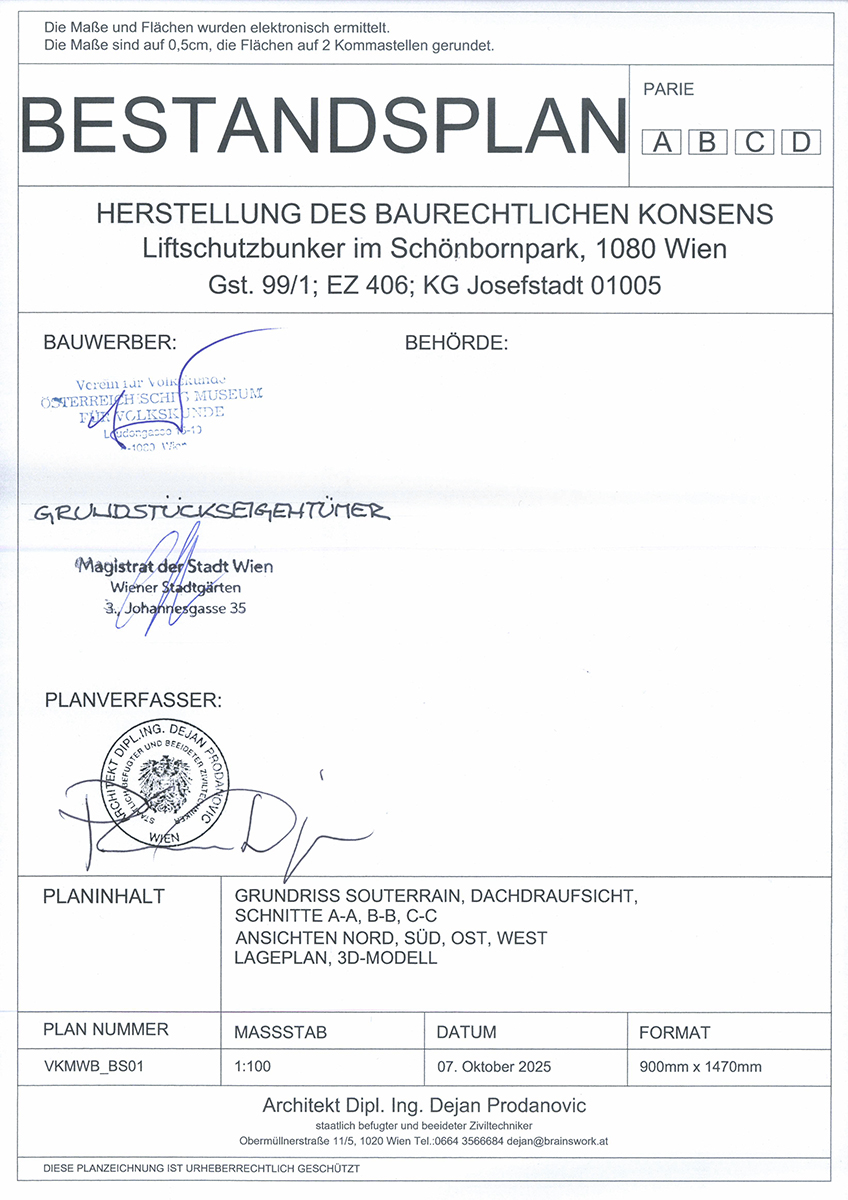
A new chapter has begun in the history of the Schönbornpark air-raid shelter since 2025 – one of recognition. When the new museum was being planned (comprehensive renovation), including using the shelter as part of this new concept, it turned out that the structure never existed administratively. The Schönbornpark air-raid shelter was never officially built (Ill. 1).
This non-existence seems to be almost symptomatic of the shelter’s history and brings together many aspects that have characterised the building and its use over the past 80 years. In and with this project, we acknowledge the building and its history of invisibility and we will continue to actively remember it. The bunker remains a bunker – the past is present.
For this reason, it is essential to keep the characteristics of the building’s biography in mind and derive ideas for the future from them. Chronologically, the initial characteristics are the denying and forgetting of the air-raid shelter’s former function during World War Two and under the Nazi system. Closely linked to this is the disappearance of the massive structure in the post-war period. Then came the grand museum visions that corresponded to – or maybe even went beyond – the requirements of the 1980s and 2020s. Everything has been about intensive negotiation processes regarding participation opportunities and interest claims. In the past, they took place around the shelter; in the future, they will take place within it – as democracy projects and other formats.
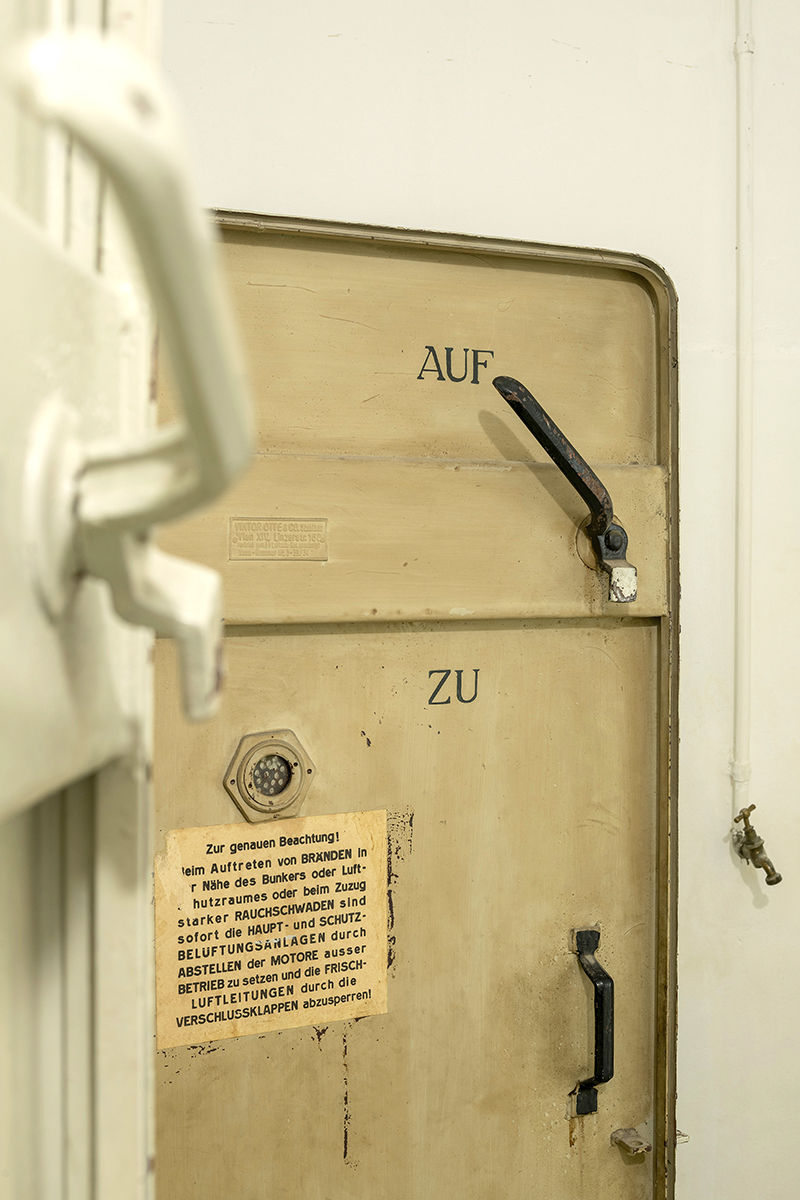
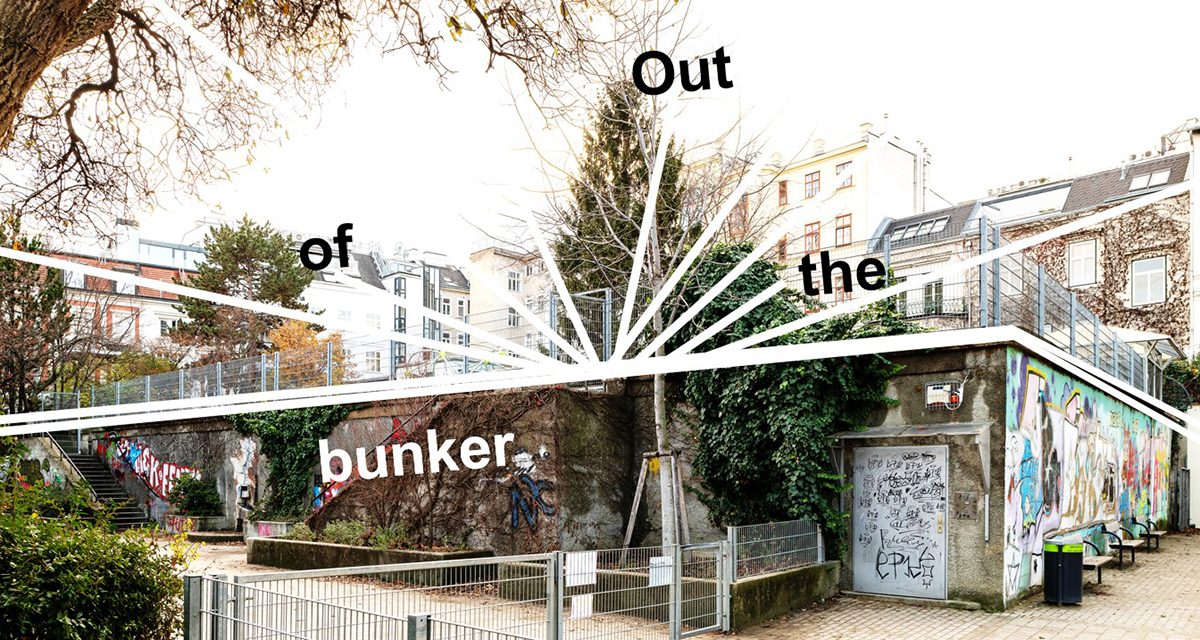
Contrary to its original function as a closed-off war and civil defence structure, the air-raid shelter will be opened when the interior renovation will take place from 2026 onward, making it available to a wider public at last (Ill. 2). After completion, it will be at the heart of a comprehensive education and awareness programme about democracy in times of illiberalism and anti-democratic movements (EU Interreg project Turning Points – Museums for a Democratic Future). Furthermore, it will offer space to various other groups and individuals who often do not have a place for their concerns and formats in what can be a closed (urban) space. Taking into account the unique structural and historical characteristics of the shelter, we – Volkskundemuseum Wien – together with our partners and users, want to think not only ‘out of the box’ but ‘out of the bunker’ (Ill. 3).
All of this only became possible in 2025. The plan for the shelter has been drawn up and submitted, official approval has been granted. Over 80 years after its actual construction, the bunker has now also been officially approved and is ready for expansion. The future has begun.
- Cf. Yifat Gutman and Jenny Wüstenberg: The Routledge Handbook of Memory Activism, New York 2023.
- Cf. the 2019 ‘Museums are not neutral’ T-shirt campaign and Mike Murawski’s book: Museums as Agents of Change: A Guide to Becoming a Changemaker, 2021.